West Bengal's Final Electoral Roll Sparks Political Storm After Contentious Revision
The publication of West Bengal's final electoral rolls on February 28 has nearly concluded one of the most contentious Special Intensive Revision (SIR) exercises in the state's recent political history. What began as a technical audit of voter records evolved into a full-scale institutional confrontation, with Chief Minister Mamata Banerjee waging an unrelenting battle against the Election Commission of India across courtrooms, streets, and through sustained political mobilization.
A Shrunken Electoral Roll with Significant Implications
According to the Election Commission's final list, the voter count now stands at 6.44 crore. This represents a net reduction of 1.22 crore voters from the pre-SIR list of 7.66 crore, marking a decline of nearly 15.9 percent. The final figures reveal that 63.7 lakh electors have been struck off, while more than 60 lakh names remain "under adjudication" and 1.9 lakh new voters have been added.
The announcement day itself was not without confusion. Bengal Chief Electoral Officer Manoj Agarwal initially stated the total number of voters at 7.04 crore during an afternoon press conference, a figure that included the 60 lakh voters whose cases remain under adjudication. By evening, the Election Commission issued a clarification excluding those names from the final count, revising the figure downward to 6.44 crore.

Among the districts witnessing the sharpest drop in voter numbers are North Kolkata, Malda, Murshidabad, and parts of North 24 Parganas and Nadia. Murshidabad has the highest number of voters under adjudication at approximately 11 lakh, followed by Malda (8.3 lakh) and North 24 Parganas (5.9 lakh), including large stretches of the politically significant Matua belt.
Mamata Banerjee's Constitutional Confrontation
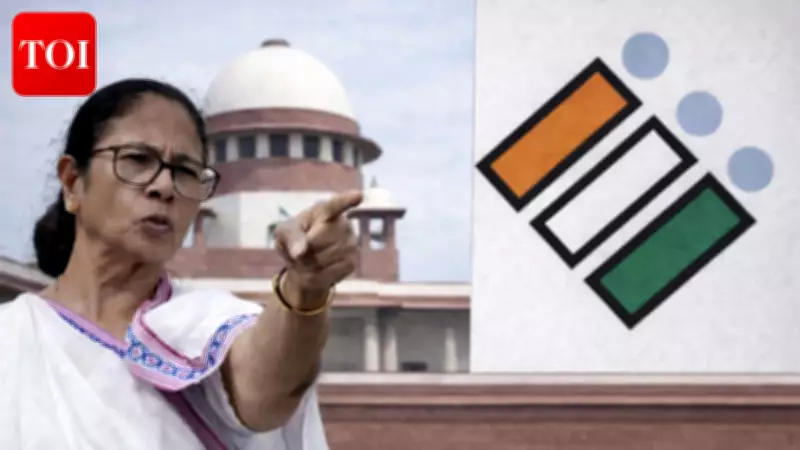
For Mamata Banerjee, the SIR became a constitutional confrontation before it became a political one. Unlike many opposition leaders who confine electoral disputes to press conferences, Mamata transformed this into street-level confrontations, physically inserting herself into moments of conflict. Her decision to personally move the Supreme Court marked a rare moment in Indian electoral politics: a sitting chief minister directly challenging an ongoing electoral roll revision and arguing in court.
In her plea, she sought scrapping of the drive, suspension of deletions, reliance on existing rolls, and acceptance of Aadhaar as a valid document. Beyond the legal relief sought, her language inside the courtroom shaped the political message outside it. "When justice is crying behind closed doors, it creates a feeling that justice is not being delivered anywhere," she declared during proceedings.
The Supreme Court's Response and Judicial Oversight
The bench led by Chief Justice Surya Kant observed that "genuine persons must remain on the electoral roll" and stressed, "Every problem has a solution and we must ensure that no innocent person is left out." While allowing the revision process to continue, the court issued notices and directed procedural transparency, including display of discrepancy lists at local offices.
In mid-February, the Supreme Court permitted deployment of additional judicial officers, including from Jharkhand and Odisha, to expedite scrutiny of nearly 50 lakh disputed cases. Invoking its powers under Article 142, the court directed that supplementary lists would be deemed part of the final roll published on February 28. However, the court also sharply rebuked the West Bengal government for what it described as repeated, "vague and irrelevant" pleas.
Political Mobilization and Ground-Level Impact
The courtroom battle was not isolated from political strategy—it anchored it. From December onwards, as draft exclusions surfaced, the All India Trinamool Congress operationalized the issue on the ground. "May I Help You" camps were set up across districts to assist voters in filing claims and objections, especially those marked under ASD (absent/shifted/dead) or "logical discrepancy" categories.

Sporadic protests broke out across districts. In Bankura, roads were blocked after around 1.2 lakh deletions were reported. In Salanpur (West Burdwan), police rescued a booth-level officer after 134 out of 632 voters in a booth were marked deleted or under adjudication. Even the roll-out had hiccups: though hard copies were displayed from noon, the online version went live only in the evening, triggering long queues at ERO and BDO offices.
Gender Dynamics in Voter Deletions
An interesting factor that emerged was the marginally less deletions of women voters. Data from the Election Commission's SIR shows women electors declined from about 3.77 crore to 3.44 crore, an 8.7 percent fall, while male voters dropped from 3.89 crore to 3.60 crore, a roughly 7.5 percent decline. Women still make up nearly half of the state's electorate.
Over the past decade, women voters have emerged as a decisive political force, forming a key pillar of support for Chief Minister Mamata Banerjee. The BJP has increasingly focused on attracting this bloc. Turnout trends highlight their growing influence, with women's participation rising from 80.75 percent in 2006 to 94.42 percent in 2016, and slightly surpassing men again in 2021.
Opposition Reactions and Political Positioning
For the BJP, the proceedings allowed a counter-claim: that the process was transparent, survived judicial scrutiny, and continued under court observation. Soon after the final rolls were published, BJP president Nitin Nabin framed the deletions as "removing infiltrators," stating, "If names of 50 lakh Bangladeshis weren't deleted by EC, Centre's welfare schemes for Bengal would have benefited infiltrators."
Leader of opposition Suvendu Adhikari pointed to the rolls in Bhowanipore, represented by Chief Minister Mamata Banerjee. "Nearly 47,000 names have been deleted from Bhowanipore. More than 14,500 names are under scrutiny. SIR has cleansed the electoral roll at Bhowanipore," he said.
The Road Ahead to 2026 Assembly Elections
Technically, the Special Intensive Revision process is not entirely over. Supplementary lists will incorporate names cleared by judicial officers, and the Election Commission of India has reiterated that rolls can be updated until the last date of filing nominations, especially if polling is conducted in phases.
Politically, however, the terrain ahead of the 2026 assembly elections in West Bengal has already shifted. The publication of the final list gives the commission procedural closure, but the intervention of the Supreme Court has injected institutional legitimacy and political interpretation into the process. For Mamata and TMC, the very fact that the matter reached the Supreme Court serves a political function, allowing her to argue that the revision was serious enough to warrant constitutional scrutiny.
As West Bengal moves toward the 2026 assembly elections, the SIR will likely be seen less as a technical roll correction and more as a political contest framed in constitutional language—one fought simultaneously in administrative offices, on public platforms, and before the highest court of the land.