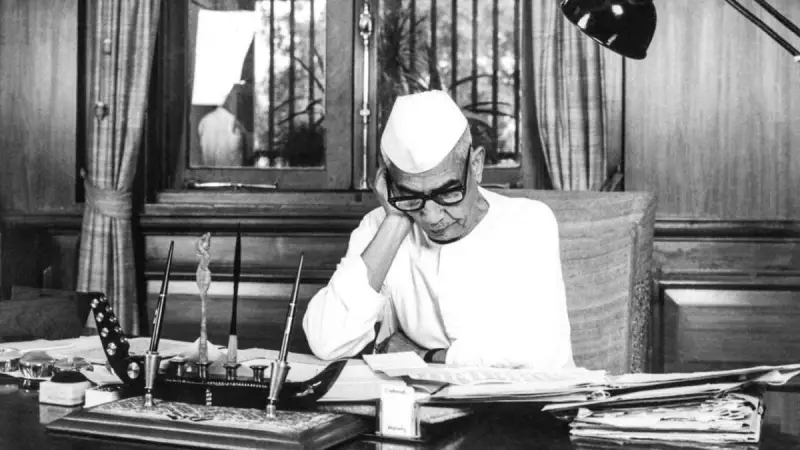
As India commemorates Kisan Diwas on December 23rd, the nation honors the legacy of its farmer leaders. Among them stands a unique figure in constitutional history: Chaudhary Charan Singh, the only Prime Minister of India who never faced Parliament while in office. This remarkable fact underscores a turbulent chapter in Indian politics, intertwining the celebration of the farmer with the paradox of a PM without a parliamentary test.
The Political Landscape of 1979: A Precarious Premiership
Chaudhary Charan Singh became the fifth Prime Minister of India on July 28, 1979. His ascent was not through a decisive electoral victory but as a compromise candidate leading a fragile coalition. He headed a Janata Party splinter group known as the Janata Party (Secular), with external support from the Congress party led by Indira Gandhi. This arrangement was inherently unstable, built on shifting loyalties rather than a solid majority in the Lok Sabha.
From the very beginning, Charan Singh's government existed on borrowed time. He was sworn in as Prime Minister without ever having proven his majority on the floor of the House. The constitutional convention requires a Prime Minister to seek a vote of confidence. However, Singh's tenure was marked by intense political maneuvering. President Neelam Sanjiva Reddy gave him time to secure his numbers, but the promised support from the Congress proved elusive and was ultimately withdrawn.

Facing the imminent prospect of a defeat in a confidence vote, Charan Singh made an unprecedented decision. On August 20, 1979, just 23 days after taking oath, he resigned without ever facing Parliament. This act etched his name into the history books for a singular distinction: a Prime Minister who governed without parliamentary accountability. His resignation letter to President Reddy is a key document highlighting his rationale, citing the withdrawal of support.
The Irony of Kisan Diwas and a Short-Lived Tenure
Charan Singh's deep connection to agrarian issues is why his birthday, December 23rd, is celebrated as National Farmers' Day or Kisan Diwas. A champion of peasant rights, his policies and writings, such as "Abolition of Zamindari," focused on land reforms and rural upliftment. This makes the nature of his premiership particularly poignant. The leader of the farmers held the nation's highest office, yet his political roots in rural solidarity could not translate into stable parliamentary numbers in a fractured political era.
His government continued in a caretaker capacity until January 14, 1980, when fresh elections were called. In those elections, Indira Gandhi's Congress returned to power with a massive majority. Charan Singh's brief tenure, therefore, remained an interlude defined by its incompleteness. He never addressed the Lok Sabha as Prime Minister, never answered questions, and never defended his policies before the elected representatives of the people.
A Lasting Legacy: The Constitutional and Historical Significance
The case of Chaudhary Charan Singh presents a fascinating study in India's parliamentary democracy. It demonstrates that while the letter of the law allows for a Prime Minister to be appointed without an immediate floor test, the spirit of the system demands parliamentary legitimacy. His situation was a direct result of the political fragmentation that followed the end of the Emergency in 1977.
This episode reinforced the critical importance of the confidence vote as the bedrock of a parliamentary system. It set a precedent that while a Prime Minister may be appointed, their authority is provisional until validated by the Lok Sabha. Subsequent political crises have often referenced this period, underscoring the need for clear majority support.
Today, as the nation observes Kisan Diwas, the story of Charan Singh is remembered on two parallel tracks. One is the celebration of his lifelong dedication to farmers, which remains his enduring contribution. The other is his unique constitutional position, a reminder of the delicate balance of power in a coalition democracy. His legacy, thus, is dual: the voice of the kisan and the PM who never faced Parliament, forever linking a day of agrarian honor with a singular anomaly in India's political history.