

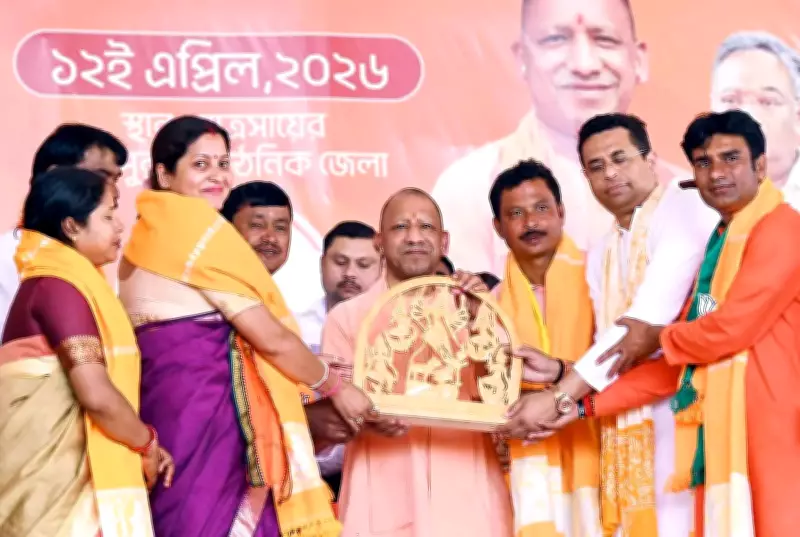
Yogi Adityanath Compares Bengal's Situation to Pre-2017 Uttar Pradesh
Uttar Pradesh Chief Minister Yogi Adityanath launched a scathing attack on the Trinamool Congress (TMC) government in West Bengal during a campaign rally on Sunday. Speaking in support of Bharatiya Janata Party (BJP) candidates across multiple Assembly constituencies, Adityanath asserted that the current state of lawlessness, violence, and appeasement in Bengal mirrors the conditions that prevailed in Uttar Pradesh a decade ago.
Allegations of Mafia Rule and Appeasement Politics
Adityanath accused the TMC of engaging in politics of appeasement, mafia dominance, and corrupt practices such as cut money, which he claimed are obstructing the development trajectory of West Bengal. He specifically targeted Chief Minister Mamata Banerjee's slogan of Maa, Maati, Manush, arguing that women feel unsafe, land is controlled by infiltrators, and citizens live in a perpetual state of fear and helplessness under her administration.
The Uttar Pradesh leader called upon the electorate to usher in a transformative change to restore Bengal's cultural identity, enhance security measures, and reignite the path of sustainable development. He emphasized that those who oppose the national song Vande Mataram should reconsider their stance in the country.

Contrasting Governance Models: UP's Transformation Post-2017
Drawing a sharp contrast, Adityanath highlighted the significant improvements in Uttar Pradesh following the establishment of a double-engine government in 2017. He noted that prior to this period, the state was frequently marred by communal riots and was often labeled as Bimaru due to its socio-economic challenges.
Today, Uttar Pradesh is recognized for its robust law and order framework, complete absence of riots and curfews, enhanced women's safety protocols, and stringent actions against illegal activities, Adityanath stated. This conducive environment has subsequently attracted industrial investments and fostered overall development.
Bulldozer as a Symbol of Governance
In a notable remark, Adityanath clarified that the bulldozer in Uttar Pradesh is not merely an instrument for infrastructure development but also a tool for acting decisively against mafia elements. Such governance efficacy is achievable only under a double-engine government, he asserted, warning that any attempts to undermine Bengal's cultural heritage, women's safety, or youth prospects would face similar strict repercussions.
Concerns Over Demographic Changes and Infiltration
The Chief Minister raised alarms about alleged attempts to alter the demographic composition in several districts, including Malda, Murshidabad, Uttar Dinajpur, Nadia, Birbhum, and Howrah. He accused the Mamata Banerjee-led government of attempting to restrict religious processions during festivals like Ram Navami while simultaneously promoting illegal infiltration networks.
Adityanath also questioned the silence of political leaders regarding violence against Hindus in neighboring Bangladesh, labeling such appeasement politics as unacceptable. He stressed the urgent need for fencing along the approximately 570-kilometer border to curb infiltration and associated illegal activities.
Economic and Agricultural Distress in Bengal
Highlighting economic disparities, Adityanath pointed out that potato farmers in Uttar Pradesh receive between Rs 15 to Rs 16 per kilogram, whereas their counterparts in Bengal are compensated with a meager Rs 1 to Rs 1.5 per kilogram. He alleged that farmers are being pushed into debt and distress under TMC rule, with youths and industries gradually migrating out of the state in search of better opportunities.
Cultural Legacy and Contemporary Challenges
Paying homage to Bengal's rich cultural legacy, Adityanath described it as a land of inspiration that has historically guided India. He recalled the contributions of luminaries such as Swami Vivekananda, Ramakrishna Paramahamsa, Lahiri Mahasaya, Syama Prasad Mukherjee, Rabindranath Tagore, and Bankim Chandra Chattopadhyay.

However, he lamented that contemporary Bengal is grappling with appeasement, corruption, disorder, and violence. Bengal once contributed nearly one-third to India's economy, but industries, MSMEs, and cultural institutions have weakened over time due to political interference, Adityanath remarked. He further alleged that BJP workers have been targeted and killed in a brazen manner under the TMC's watch.
Concluding his address, Adityanath pointed to the construction of the Ram Temple in Ayodhya as a symbol of transformative development, asserting that Bengal now requires similar initiatives focused on good governance and cultural revival to reclaim its former glory.





