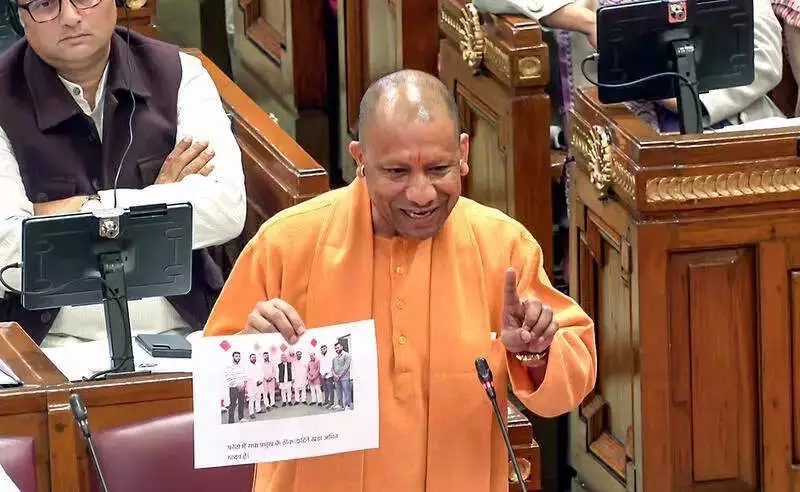
Uttar Pradesh Chief Minister Yogi Adityanath on Monday launched a sharp critique against the Congress party and Muhammad Ali Jinnah, holding them responsible for India's cultural division and the eventual Partition. Speaking in the state Legislative Assembly, he identified the compromise made over the national song 'Vande Mataram' as the inaugural and most perilous act of the Congress's politics of appeasement.
The Historical Betrayal on Vande Mataram
Initiating a landmark discussion on Vande Mataram during the winter session, the Chief Minister stated that the Congress's concessions on the song directly fostered separatist sentiments. The Uttar Pradesh assembly became the first legislative house in the country to hold such a debate. Yogi Adityanath questioned the decision to shorten the song. "The national anthem, meant to be sung in six verses, was cut down and confined to just two. Was this due to religious pressure, or a calculated conspiracy to mortgage national consciousness for political survival?" he asked the House.
The CM presented a detailed chronology, arguing that Vande Mataram was uncontroversial as long as Jinnah remained within the Congress fold. "Once Jinnah left the Congress, he weaponized the song for the Muslim League, deliberately painting it with communal colors. The song remained unchanged, but the agenda behind opposing it shifted," Yogi alleged.

Congress's 'Surrender' and the Path to Partition
He cited specific historical instances to bolster his argument. On October 15, 1937, Jinnah raised slogans against Vande Mataram from Lucknow. Merely five days later, on October 20, Jawaharlal Nehru, then Congress President, wrote to Subhas Chandra Bose expressing that the song's background was causing discomfort among Muslims. The CM termed this letter a "clear admission of the Congress's appeasement policy."
The situation escalated quickly. By October 26, 1937, the Congress Working Committee decided to drop certain stanzas of the song in the name of "harmony," a move Yogi described as a "sacrifice of national consciousness." He further noted that in March 1938, when Jinnah demanded a complete change to Vande Mataram, the Congress offered no resistance. "This emboldened the Muslim League, sharpened separatist tendencies, and marked the first major compromise on a cultural symbol. This sequence ultimately laid the foundation for India's Partition," the Chief Minister asserted.
Political Mask Over Religious Faith
Yogi Adityanath emphasized that the opposition to Vande Mataram was never genuinely religious but purely political. He recalled that from 1896 to 1922, singing Vande Mataram was a standard tradition at Congress conventions, a period free from fatwas or religious objections. "The problem emerged when politics began to wear a religious mask, a tactic employed by the Congress," he stated.
He highlighted that leaders like Maulana Abul Kalam Azad supported the song, and no one initially deemed it 'anti-Islam'. The first significant protest came in 1923 from Mohammad Ali Jauhar during a Congress session, which Yogi linked to the 'Khilafat' political movement rather than faith. From that point, according to him, the Congress began capitulating to protests against the national song.
Despite internal support from figures like Rafi Ahmad Kidwai, who called Vande Mataram a symbol of the freedom struggle, the Congress sidelined such voices, Yogi claimed. Instead of defending the song, the party formed committees and eventually decreed in 1937 that only two stanzas would be sung, and even that was not mandatory. The CM labeled this decision a "national surrender."
Legacy and Contemporary Warnings
Yogi Adityanath connected this historical narrative to the present, warning that certain political forces are attempting to revive the same divisive mindset today. He also accused the Congress of insulting democracy by imposing the Emergency in 1975, which coincided with the centenary celebrations of Vande Mataram.
Praising the song's profound legacy, he quoted Mahatma Gandhi, who called it a 'national spirit,' and Rabindranath Tagore, who described it as the 'soul of India.' He noted that the first tricolor hoisted abroad by Madam Bhikaji Cama bore the words Vande Mataram, and revolutionary Madan Lal Dhingra's last words were the same.

The Chief Minister concluded by stating that the vision of 'Ek Bharat Shreshtha Bharat' under the Modi government is fulfilling the dreams of Bankim Chandra Chattopadhyay, the song's author. He also pointed out a symbolic coincidence: the Constituent Assembly accorded Vande Mataram the status of a national song on January 24, 1950, the same year the United Provinces were renamed Uttar Pradesh.