

Budget Session Commences Amidst Opposition Demands and Government Rejection
The Budget Session of Parliament is set to begin on Wednesday, January 29, 2026, and will continue until April 2, 2026. This session marks a crucial period for legislative activities and policy discussions in the Indian Parliament. The first phase of the session will conclude on February 13, with Parliament reassembling on March 9 for the second phase.
All-Party Meeting Sets the Tone for Session
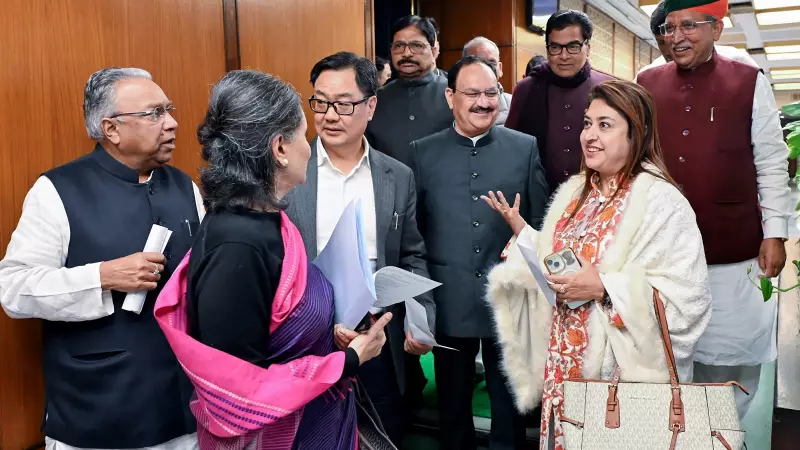
On the eve of the Budget Session, an all-party meeting was held in New Delhi on Tuesday, January 28, 2026. This meeting brought together key representatives from both the government and the Opposition to discuss the agenda and expectations for the upcoming session. From the government side, notable attendees included Defence Minister Rajnath Singh and Parliamentary Affairs Minister Kiren Rijiju. The Opposition was represented by prominent figures such as Congress MP Jairam Ramesh, TMC's Sagarika Ghose, CPI(M)'s John Brittas, and CPI's P Sandosh Kumar.
Opposition Demands and Government Response
During the all-party meeting, a united Opposition put forward several demands for discussions in Parliament. Key among these were requests for debates on foreign policy issues, the Special Intensive Revision (SIR), and the VB-G RAM G Act, which has replaced the Mahatma Gandhi National Rural Employment Guarantee Act (MGNREGA). However, the government firmly turned down the demands for discussions on SIR and the G RAM G Act.

Parliamentary Affairs Minister Kiren Rijiju, in a press briefing after the meeting, emphasized that the G RAM G Act must be followed now that it is law. He stated, "Once a law is before the nation, we have to follow it. We cannot reverse the gear and go back." On the demand for a discussion on SIR in West Bengal, Rijiju noted that both Houses had extensive discussions on electoral reforms in the last session, where this issue was also raised by the Opposition, making another debate unnecessary.
Criticism Over Legislative Business Details
The Opposition also slammed the government for not circulating the list of legislative business for the upcoming session ahead of time. Sources indicated that Opposition parties expressed concerns over this lack of transparency. An Opposition MP present at the meeting revealed, "After the meeting, they circulated a list of pending bills. The government said the intended agenda will be circulated after the President's Address." In response, Rijiju assured that he is ready to share the list and has instructed officers to do so, though he noted that it is customary to share such details after the President's Address in the first session of the year.
Foreign Policy and Centre-State Relations Raised
On the foreign policy front, the Opposition raised several critical issues during the meeting. These included concerns over repeated "humiliation of India by US President Donald Trump" and India's perceived "silence" on crucial international matters such as Palestine, Iran, Venezuela, and Greenland. Additionally, parties like the DMK, TMC, and CPM demanded a discussion on Centre-state relations. They alleged that the office of the governor is "being misused to disrupt the functioning of state governments, and central agencies are being misused."
Looking Ahead to the Session
Rijiju highlighted that the Opposition MPs presented several issues at the meeting, and these can be raised during the debate on the President's Address. He reiterated that this is the first session of the year, and typically, the list of government business is shared after the President's Address. The Budget Session is expected to be a platform for robust debates and discussions on a wide range of national and international issues, setting the tone for the legislative year ahead.






