Opposition Parties Launch Scathing Attack on India-US Trade Deal in Rajya Sabha
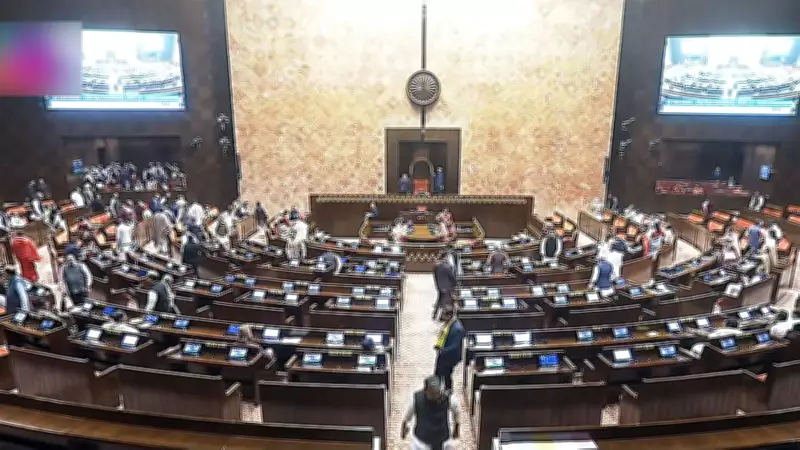
The Rajya Sabha witnessed heated exchanges on Tuesday as Opposition parties launched a fierce critique of the Union government's economic policies during the ongoing discussion on the 2026-27 Union Budget. The focus of the attack was the interim trade agreement between India and the United States, with lawmakers questioning its implications for farmers, foreign relations, and domestic economic inequality.
Opposition Raises Concerns Over Trade Deal and Economic Performance
Trinamool Congress MP Sukhendu Sekhar Ray led the charge, criticizing what he termed as "drum beating" around the interim trade deal with the US. He demanded clarity from the Centre on whether India had abandoned its "time-tested friend" Russia by agreeing to halt oil purchases in favor of aligning with a nation that has historically opposed India on various fronts.
Congress MP Jebi Mather Hisham echoed these concerns, specifically questioning the benefits of the deal for Indian farmers, asking, "What is so wonderful in this agreement for our agricultural community?" RJD's Manoj Kumar Jha shifted the focus to domestic issues, highlighting the persistent problem of unemployment and urging the government to address this critical challenge.

Further criticism came from NCP (SP) MP Fauzia Khan, who pointed out that India's ranking in the Human Development Index remains significantly below the global average, underscoring broader socio-economic disparities.
NDA Defends Policies, Accuses Opposition of 'Wilful Ignorance'
In a robust defense, Treasury bench members countered that Opposition parties were exhibiting "wilful ignorance" regarding the government's economic achievements. They emphasized that the European Union's recent major trade deal with India, rather than China, was a testament to the vitality of the Indian economy.
Shiv Sena MP Murli Deora commended the Finance Minister for presenting a budget during what he described as a "volatile and disruptive" global period, unseen since the end of World War II. He praised the NDA government for initiating a "tectonic shift" in economic thinking, particularly in revitalizing the manufacturing sector, which he claimed had been neglected by previous regimes.
In a veiled reference to Congress leader Rahul Gandhi, Deora added, "Some individuals, both overseas and domestically, have displayed wilful ignorance by labeling our economy as dead. If that were true, how could India be the fastest-growing economy in the world?"
BJP MP Surendra Singh Nagar also praised the budget, noting that listening to senior Congress leader P Chidambaram might lead one to believe nothing positive was occurring in the country, contrary to the government's assertions of progress.
TMC MPs Walk Out Over 'Mini Pakistan' Remark
The session descended into chaos when BJP MP from West Bengal, Samik Bhattacharya, referred to an encroached area in Kolkata as "mini Pakistan" during Question Hour. He stated, "It is a matter of record that approximately 170 acres of prime port land are under encroachment and illegal occupation. A substantial portion of this is in Garden Reach, Metiabruz, and Khidirpur areas, which have been publicly called mini Pakistan by the mayor of Kolkata."
This remark provoked immediate protests from Trinamool Congress MPs, who subsequently staged a walkout in objection to the terminology used. The incident underscored the tense atmosphere in the Upper House, with Rajya Sabha Chairman C P Radhakrishnan eventually adjourning the proceedings amid the uproar.
Broader Implications and Ongoing Debates
The debate reflects deepening political divisions over India's economic direction and international engagements. While the Opposition scrutinizes the India-US trade deal for its potential impact on traditional alliances and domestic sectors, the NDA government maintains that such agreements are crucial for positioning India as a global economic leader.
As the Budget Session continues, these discussions are expected to intensify, with both sides preparing to leverage economic data and policy outcomes to bolster their arguments in the coming days.