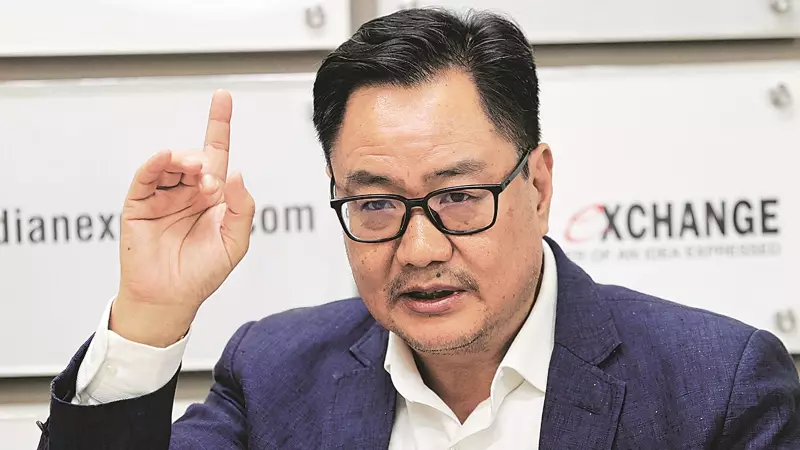
Union Minister for Parliamentary Affairs and Minority Affairs, Kiren Rijiju, has underscored the foundational role of trust and ethics in India's parliamentary democracy, warning that its breach triggers a damaging cascading effect. His remarks come at a time when the government is navigating turbulent parliamentary sessions marked by an agitated Opposition, primarily protesting the Election Commission's Special Intensive Revision (SIR) of electoral rolls.
On Parliamentary Disruptions and Opposition Strategy
In an exclusive Idea Exchange interaction moderated by Deputy Editor Liz Mathew of The Indian Express on December 8, 2025, Rijiju addressed the frequent washouts of recent sessions. While acknowledging that the last session was technically productive in passing bills, he lamented the lack of substantive debate, which he termed painful for the democratic spirit.
Rijiju defended the government's efforts to engage with the Opposition, citing his regular meetings with leaders like Rahul Gandhi and Mallikarjun Kharge. He placed the onus for smooth functioning on the Opposition's conduct. "If the Opposition wants to use Parliament for their political purpose, then they should use it more wisely," he stated, arguing that disruptions rarely yield political dividends.

He drew a sharp contrast with past protests, recalling that during LK Advani's tenure as Leader of Opposition, BJP MPs ensured they did not cross the treasury benches. He criticized current tactics where members physically block ministers.
The SIR Controversy and Limits of Discussion
A significant point of contention has been the Opposition's demand to discuss the SIR. Rijiju firmly stated that Parliament cannot discuss the actions of autonomous constitutional authorities like the Election Commission. "SIR is an administrative action taken by the Election Commission, not a reform by the government... how can Parliament take that up for discussion?" he asked, invoking past rulings by Speakers that such matters are inadmissible.
On the broader issue of passing bills without extensive prior consultation, as seen with the CAA and Article 370, Rijiju explained the necessity of Cabinet secrecy. He highlighted that the government has referred several bills, like the Waqf (Amendment) Bill and the Jan Vishwas Bill, to Joint Parliamentary Committees for scrutiny.
Minority Safety and Addressing Ladakh's Concerns
Wearing his hat as the Minority Affairs Minister, Rijiju robustly countered allegations of discrimination against minorities, particularly Muslims. He asserted that the freedoms and opportunities for minorities in India are unmatched. "I am a minority. Has any minority fled from India?" he questioned, claiming communal riots have reduced by over 95% compared to pre-2014.
Regarding the prolonged agitation in Leh demanding the Sixth Schedule and statehood, Rijiju pointed to the developmental benefits accrued since the removal of Article 370. He urged patience, stating that dialogue between Ladakhi leadership and the Home Ministry should be allowed to proceed without political interference. On activist Sonam Wangchuk's detention, he declined to comment on individuals, focusing instead on the welfare of common people.
China's Stance on Arunachal and Political Discourse
Responding to China's repeated claims over Arunachal Pradesh and visa denials to its residents, Rijiju, an MP from the state, was unequivocal. "No matter how much China or anybody says, it will not alter the status of Arunachal Pradesh," he declared. He urged China to accept the reality and foster a friendly relationship, emphasizing that no Arunachali would ever accept alignment with China.
Reflecting on the deterioration of parliamentary discourse, Rijiju expressed concern over the use of unparliamentary language and rhetoric aimed at creating social media headlines. He indirectly criticized Rahul Gandhi's approach, suggesting it diminished his seriousness. While admitting a decline in standards, he concluded that the ultimate victims of a non-functioning Parliament are the Opposition MPs themselves, who lose the platform to showcase their performance to constituents.