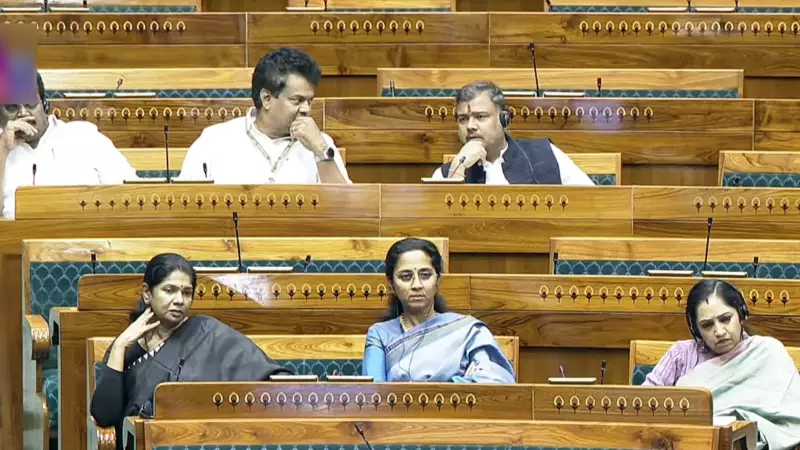
In a significant move aimed at reshaping India's work culture, Nationalist Congress Party (SP) MP Supriya Sule on Friday introduced a Private Members' Bill in the Lok Sabha seeking to legally empower employees to ignore work-related calls and emails outside their official working hours. This marks the second time since 2019 that the Baramati MP has proposed legislation on the 'right to disconnect'.
The Legislative Push for Work-Life Balance
The proposed Right to Disconnect Bill, 2025 seeks to formally recognise the right of employees to disconnect from digital communication tools after work. The Bill's 'Objects and Reasons' section cites a World Economic Forum report, highlighting the detrimental effects of constant connectivity. It points to risks like sleep deprivation, heightened stress, emotional exhaustion, and a destroyed work-life balance due to 'telepressure'—the persistent urge to respond to calls and emails.
The legislation warns of 'info-obesity', a condition where the brain is overtaxed by constant monitoring of work messages. Congress MP Shashi Tharoor joined the legislative effort on the same day, introducing the Occupational Safety, Health and Working Conditions Code (Amendment) Bill, 2025. Tharoor's bill complements Sule's by seeking to limit work hours, secure the right to disconnect, and establish grievance redress and mental-health support systems.

Key Provisions of the Proposed Law
Sule's draft law outlines several concrete measures designed to protect employees' personal time. The core proposal is that while an employer may contact a worker after hours, the employee is not obliged to reply and has the right to refuse such communication. Crucially, an employee cannot face disciplinary action for exercising this right.
The Bill mandates the creation of an Employees’ Welfare Authority. This body would be tasked with conferring the right to disconnect, conducting a baseline study on workers' after-hours digital tool usage, and directing companies with more than 10 workers to negotiate terms for overtime work, which must be compensated at the normal wage rate.
Other notable provisions include:
- Government and companies must provide counselling services to help maintain work-life balance.
- Establishment of digital detox centres.
- A penalty for non-compliant companies set at 1% of the total remuneration of affected employees.
A Global Trend Meets Indian Parliamentary Reality
The push for a right to disconnect aligns India with a global movement. Countries like France, Portugal, and Australia have already enacted similar laws to combat the erosion of leisure time in a hyper-connected world. The concept echoes the historic labour movement slogan for "eight hours for work, eight hours for rest, and eight hours for what you will."
This issue has gained traction in Indian states as well. In September 2025, Kerala Congress (M) MLA Dr N Jayaraj proposed the Kerala Right to Disconnect Bill, sparking online debates. However, the path for Private Members' Bills in Parliament is notoriously challenging. They are only taken up on Fridays during sessions, and since independence, only 14 such bills have become law. The last one was passed over five decades ago, on August 9, 1970.
The introduction of these bills by Sule and Tharoor has ignited a crucial conversation about the future of work in India, questioning whether legal boundaries are needed to safeguard personal time in the digital age.