

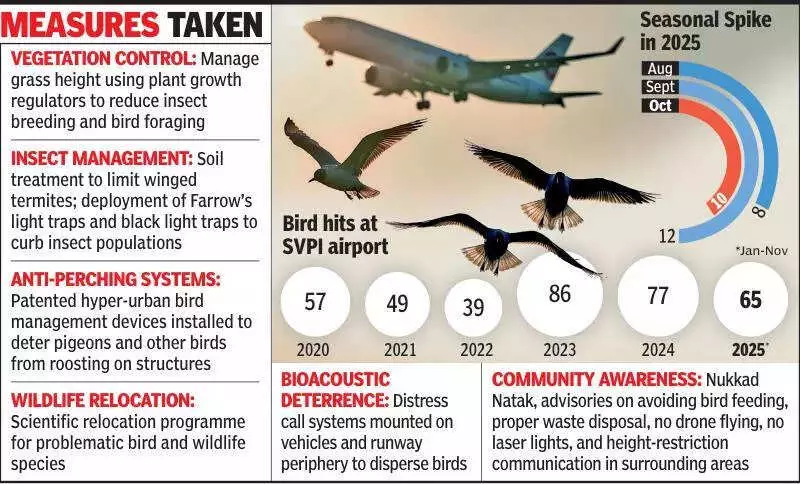
Ahmedabad's Sardar Vallabhbhai Patel International Airport (SVPIA) has managed to keep bird-strike incidents broadly stable this year, despite the perennial challenge posed by the post-monsoon months. Airport data reveals that while the period from August to October continues to be the most difficult for aircraft safety, a comprehensive wildlife management program is helping to control the situation.
Seasonal Spikes and a Five-Year Trend
Airport officials have recorded approximately 65 bird-strike incidents between January and November 2025. A clear seasonal pattern emerged, with a noticeable rise to 8-10 cases per month in August, September, and October. This aligns with historical data showing the post-monsoon phase as the peak period for such hazards.
Looking at a longer timeline provided by the civil aviation ministry, the numbers at Ahmedabad airport have seen fluctuations. After a sharp climb to 86 incidents in 2023, there was a marginal improvement to 77 cases in 2024. The previous year, 2022, had seen a low of 39 strikes. For the first half of 2025, 29 incidents were recorded between January and June, reinforcing the established seasonal cycle.

The Multi-Pronged Strategy for Wildlife Management
Airport operators credit the relative stabilization to a multi-layered wildlife management programme rolled out in recent years. As flight traffic grows and urban development encroaches around the airport, these interventions have become crucial for safe operations.
A key shift involved active vegetation management. By using plant growth regulators to control grass height, the airport has successfully reduced the insect population that attracts foraging birds. This is particularly effective against black kites, a species frequently involved in bird strikes across western India.
The strategy is complemented by intensified insect control measures. These include treating soil to limit termite activity and deploying high-capacity traps like Farrow's and black light traps to curb insect populations further.
Structural Deterrents and Scientific Relocation
Beyond habitat management, physical adjustments have played a significant role. The airport has installed customized anti-perching devices based on patented technology on buildings and structures. These devices restrict access to ledges and protrusions, effectively reducing roosting by pigeons and other birds.
Additionally, Sardar Vallabhbhai Patel International Airport operates one of India's earliest programmes for scientific wildlife relocation. This holistic approach, combining habitat modification, pest control, and physical barriers, forms the backbone of its efforts to mitigate risks for aircraft during takeoff and landing, especially in the challenging post-monsoon season.






