

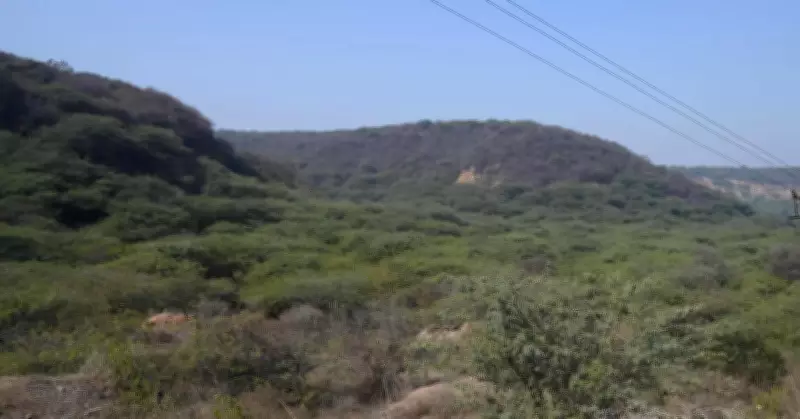
Gurgaon: The composition of the high-powered committee (HPC) tasked by the Supreme Court with defining the Aravali Hills and Ranges has drawn caution from environmentalists, two of whom are petitioners in the case. They question how a committee led by a bureaucrat reporting to the central government can be considered impartial or independent, and fulfill the court's objective of a “fair, impartial and independent” expert assessment of measures needed to protect the hill ranges that stretch from Gujarat to Delhi and have been severely degraded by mining.
Committee Composition
The HPC will be headed by the director general of the Indian Council of Forestry Research and Education (ICFRE). Other members include former Forest Survey of India director general Subhash Ashutosh, former Geological Survey of India director Rajendra Kumar Sharma, former Union environment ministry joint secretary Brij Mohan Singh Rathore, and former Delhi University botany professor Ashok K Bhatnagar. Special invitees are Prof Jagdish Krishnaswamy of the Indian Institute for Human Settlements and Prof Laxmikant Sharma of Central University of Haryana. The need for an HPC arose after an earlier committee finalised a definition of Aravalis—recognising any hill with an elevation of 100 metres or more—which triggered widespread protests in Rajasthan.
Environmentalists' Concerns
Environmentalists point out that ICFRE functions under the Union Ministry of Environment, Forests and Climate Change, whose secretary chaired the earlier committee. Since the same secretary continues in office, they question how a subordinate institution can reassess those findings. RP Balwan, forest conservator of south Haryana and a petitioner, said, “By and large, this committee looks more like the view of government than an independent one.” A retired Haryana IFS officer added, “A retired judge or an independent expert working on Aravali issues could have headed the committee. The current HPC looks like a sub-committee of the environment ministry.”

Environmentalist SS Oberoi, another petitioner, echoed similar concerns: “When a definition decided by the government itself is under scrutiny, it cannot be asked to sit in judgment over its own mistakes. The earlier committee was headed by the forest secretary, and now a junior officer from an institution under the same ministry has been asked to review it. How will this be an independent review?”
Supreme Court's Justification
The Supreme Court justified the panel's constitution by emphasising the need for multidisciplinary expertise. The court observed that decisions with far-reaching environmental consequences should not be taken without expert evaluation, and that the committee would assess issues related to geology, biodiversity, flora and fauna, mineral resources, and scientific geo-mapping of the Aravali landscape.
Tasks and Timeline
The committee has been tasked with examining contentious questions, including whether restricting the definition of the Aravali range to areas within 500 metres between two or more hills could narrow protected land and increase areas available for mining. It will also assess concerns that the proposed 100-metre elevation criterion could leave thousands of smaller hills and hillocks outside environmental protection. The court directed the committee to invite representations from state governments, environmentalists, conservationists, mining lease holders, project proponents, villagers, farmers, mine workers, and local communities before finalising recommendations. The report is due by August 31, after which the Supreme Court will take up the matter again on September 7.






