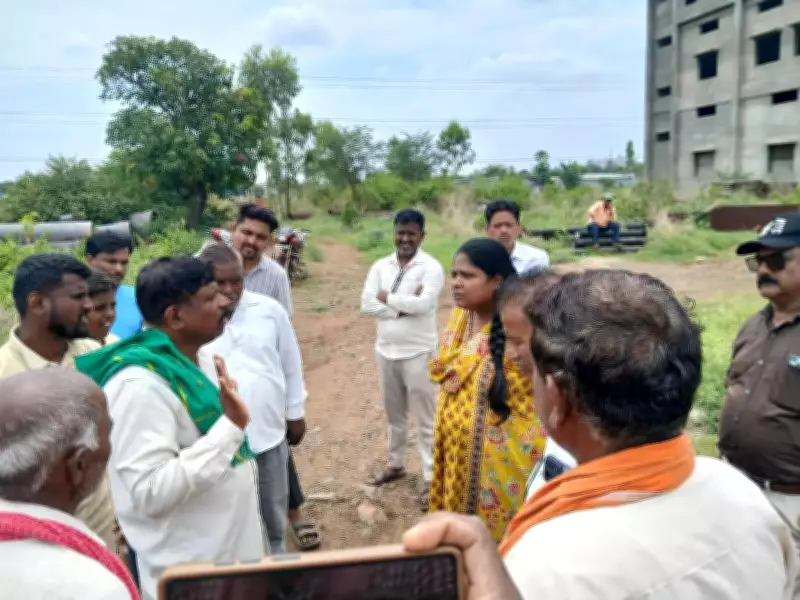
Belagavi: Farmers of Halaga on Tuesday stalled work once again on the long-pending sewage treatment plant (STP), voicing dissatisfaction over compensation, despite claims by former minister Laxmi Hebbalkar that the issue had been resolved with a Rs 50 lakh ex-gratia package.
Project Background
The Halaga STP, a major infrastructure project on the outskirts of Belagavi city under the Centre’s AMRUT scheme, has been delayed for over 15 years due to persistent land acquisition and compensation disputes. The project, spread over 19.2 acres and estimated at Rs 162 crore, is being executed by the Belagavi City Corporation (BCC) and Karnataka Urban Water Supply and Drainage Board (KUWSDB), with a planned capacity of 70 MLD.
History of Disputes
The dispute dates back to the initial compensation fixed at Rs 3 lakh per acre during the tenure of then MLA Sanjay Patil. Farmers challenged the acquisition in court, following which repeated attempts were made to negotiate the terms. Hebbalkar had earlier supported farmers’ demand for higher compensation, reportedly up to Rs 4 crore per acre, causing further delays. In 2016, then district minister Ramesh Jarkiholi offered Rs 30 lakh per acre, which was rejected. Recently, Hebbalkar stated farmers were satisfied with the Rs 50 lakh ex gratia and that the long-pending issue is settled. However, the renewed protest indicates otherwise.

Farmers’ Demands
Farmer leader Prakash Naik said prevailing land prices in the area range between Rs 10 lakh and Rs 12 lakh per gunta (over Rs 4 crore per acre). “Farmers are not satisfied with Rs 50 lakh ex-gratia. The land is prime, located near Suvarna Vidhana Soudha and along National Highway-48. We demand fair compensation,” he said, adding Rs 89 lakh per acre was recently sanctioned for land in Basurte village for a check-dam project.
Naik also alleged that officials are pressuring farmers to accept the package and sign promissory notes waiving their right to approach courts. “We will not tolerate this,” he warned.
Environmental Impact
Meanwhile, the project’s delay continues to have environmental consequences, with an estimated 30 to 35 MLD of untreated sewage flowing into the Markandeya River through the Ballari Nala due to the incomplete facility.