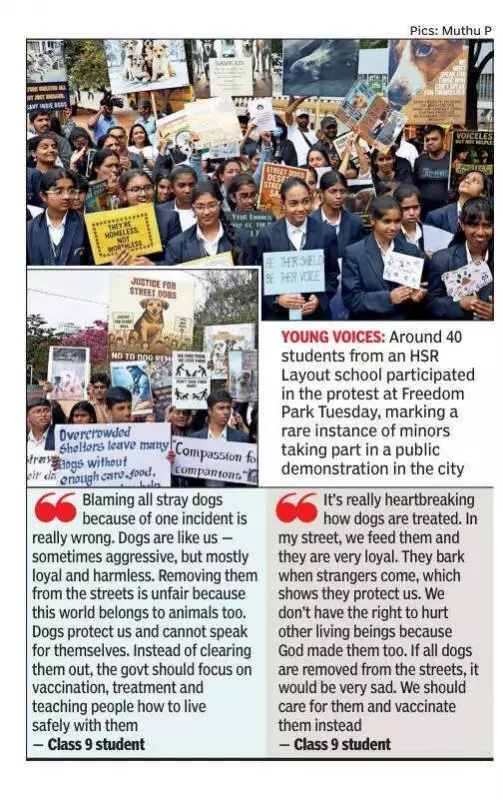
A protest against the Supreme Court's recent directives on managing stray dogs in Bengaluru saw a significant and unusual development on Tuesday. Schoolchildren joined animal welfare activists and concerned citizens at Freedom Park, raising critical questions about the practicality of implementing the court's orders in a city grappling with inadequate shelter infrastructure.
Students Raise Voices for Humane Treatment
In a rare sight for the city, approximately 40 students from classes 8 and 9 of Lawrence High School in HSR Layout participated in the demonstration. Their presence marked a notable instance of minors engaging in a public protest in Bengaluru. The school authorities clarified that the students attended voluntarily and with proper parental consent. A teacher stated that the children were motivated by their own observations and were not coerced into participating.
The young protesters, alongside other activists, argued that the Supreme Court's fiat, which involves relocating or confining stray dogs, is deeply flawed given the current ground reality. They emphasized that the Greater Bengaluru Authority (GBA) lacks the necessary facilities to humanely handle a large-scale removal of street dogs. Confining animals without functional shelters, they contended, would be both impractical and cruel, causing immense distress to the dogs and disrupting the existing ecosystem of coexistence in residential areas.

Personal Bonds and Calls for Sustainable Solutions
At the protest, organized by the group South Bengaluru Cares, students shared heartfelt accounts of their daily interactions with community dogs. They described the strays as familiar and often protective presences in their neighbourhoods. Several children challenged the narrative of collectively blaming dogs for isolated bite incidents, pointing out that canine aggression typically stems from fear, neglect, or prior mistreatment.
One student poignantly remarked that removing these dogs would feel like "separating friends," acknowledging the bonds formed with residents who regularly feed and care for them. Another highlighted that barking is a natural defensive mechanism, and animals cannot verbally explain themselves when they feel threatened or provoked.
The collective appeal from the protesters was clear. They urged the civic authorities to adhere to the humane spirit within the Supreme Court's order, particularly the condition that dogs should only be moved to locations where proper shelter facilities exist. Instead of mere removal, they advocated for a more sustainable approach focused on:
- Mass vaccination drives to control rabies.
- Systematic sterilization programs to manage the population humanely.
- Public awareness campaigns to foster responsible community interaction with strays.
The protest underscored a growing public sentiment in Bengaluru that seeks compassionate and infrastructure-backed solutions to human-animal conflict, moving beyond punitive measures against street dogs.