

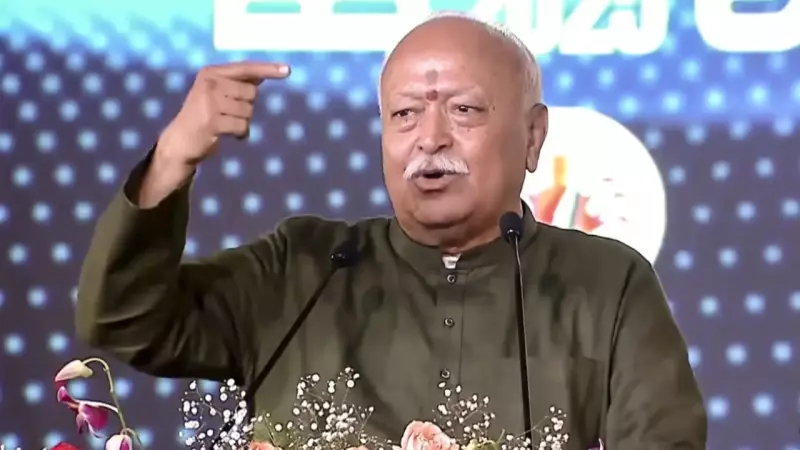
Rashtriya Swayamsevak Sangh (RSS) chief Mohan Bhagwat on Tuesday declared that India's ascent on the world stage is an undeniable certainty. However, he emphasized that this growth must be steered by a profound responsibility to present a meaningful and compassionate model to humanity, rather than merely chasing national advancement or material supremacy.
A Critique of Western Development Paradigms
Speaking at the seventh edition of the Bharatiya Vigyan Sammelan 2025, organized by Vigyan Bharati, Bhagwat offered a critical analysis of contemporary development models. He argued that the paradigms which have dominated, particularly in the West, have indeed generated material wealth but have simultaneously led to severe social fragmentation and ecological crisis. "When we look at developed countries today, we see that development has come with destruction," he stated, pointing out that many societies are now reconsidering growth models that elevate consumption above all else, neglecting balance.
Bhagwat anchored his argument in the fundamental purpose of progress: human well-being, or sukh. He stated that the trajectory of any society's development hinges on how it defines happiness itself. "All development is for happiness. Human beings want happiness; everyone in creation wants happiness," he remarked. Questioning purely utilitarian approaches to science and knowledge, he illustrated, "Why do we want to know how far the sun is? Because human beings have a thirst to know, and on the basis of that knowledge they want to make their lives happy."

India's Civilisational Alternative: Beyond Material Satisfaction
The RSS chief provided a historical critique, suggesting that for the past two millennia, global systems have largely confined the idea of happiness to material satisfaction. He compared this reduction to basic animal instincts centered on food, sleep, fear, and survival—benchmarks he deemed wholly insufficient for measuring genuine human progress.
In contrast, he presented India's civilisational worldview as offering a more holistic path. "Food, clothing, housing, health and education are necessary, and suffering must be reduced. But we should not stop there," Bhagwat urged. He elaborated that Indian philosophy has always acknowledged both outer material needs and inner well-being, asserting that true happiness originates from within and cannot be sustained in isolation from the broader society and the natural world.
He issued a strong warning against development strategies that exacerbate social divisions. "Development should not produce two classes — the happy and the unhappy, the haves and the have-nots. That is wrong development," he cautioned. Bhagwat explained that inequality stemming from uneven access and opportunity inevitably sows the seeds of conflict and instability, undermining the very foundation of progress.
Dharma as the Guiding Principle for Balanced Growth
Bhagwat proposed that India's growth narrative must be firmly rooted in ethical restraint and equilibrium, which he defined as dharma. He clarified, "Dharma is not ritual or religion; it is that which sustains. It ensures harmony between individual progress, social welfare and nature." This principle, he suggested, should act as the bedrock for a uniquely Indian model of development that avoids the pitfalls observed elsewhere.
The conference, which saw participation from scientists, academics, and policymakers across the nation, focused on the critical task of aligning scientific inquiry with sustainability, ethics, and India's indigenous knowledge traditions. Organizers framed the event as a concerted effort to sculpt a distinctively Indian vision for science-led development that is both progressive and principled.






