

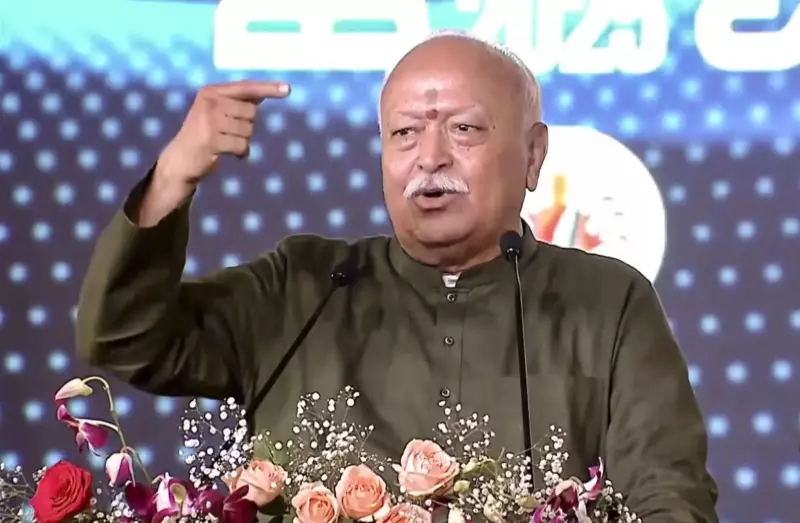
Rashtriya Swayamsevak Sangh (RSS) chief Mohan Bhagwat made a significant intervention in the ongoing discourse on science and spirituality, stating there is "no contradiction" between the two. He delivered these remarks while addressing the Bharatiya Vigyan Sammelan on Friday in Tirupati, Andhra Pradesh.
Dharma is Not Religion, It's the Governing Science
Bhagwat began by clarifying a common misconception, emphasizing that dharma is often "misunderstood" as religion. He presented an alternative definition, describing dharma as the fundamental "science governing the functioning of creation." According to him, it is the immutable law that underpins all existence. "Dharma is not religion. It is the law by which creation runs. No one can function outside it," he stated. He warned that any imbalance in this natural law inevitably leads to destruction.
Converging Paths to the Same Truth
The RSS chief addressed the historical rift between scientific inquiry and spiritual pursuit, labelling the notion that dharma has no place in science as "fundamentally incorrect." He argued that while their methodologies diverge, their ultimate goal is identical.

"There is no conflict between science and dharma or spirituality. The methodologies may differ, but the destination is the same — knowing the truth," Bhagwat remarked. He elaborated that science relies on external observation, experimentation, and repeatable results. Spirituality, he said, follows a parallel path but focuses on inner experience and disciplined practice, aiming for a direct, universally attainable realization.
He drew a distinction in their domains: science modifies the external, material world, while spirituality operates in the inner, subtle realm. Intriguingly, he noted that modern science's evolving view of consciousness as universal, rather than localized, finds echoes in ancient Indian philosophical concepts like "Sarvam Khalvidam Brahma" and "Prajnanam Brahma."
The Critical Role of Indian Languages
Shifting focus to education and dissemination, Bhagwat stressed the paramount importance of language. He asserted that Indian languages uniquely encapsulate the essence of dharma and argued for the urgent need to teach and communicate scientific knowledge in mother tongues.
He cited the example of Finland, where students are taught in their native language until the eighth grade, supported by robust teacher training programs. This model, he implied, is worthy of emulation in India to foster deeper understanding and innovation.
A New Vision for India and the World
Concluding his address, the RSS chief expressed a forward-looking vision. He voiced confidence that by integrating material progress with the principles of dharma, India could present a transformative model to the world.
This synthesis, he believes, would offer a "new vision" to humanity, enabling nations to advance collectively not as conquerors of nature, but as "caretakers of creation." His speech positioned India's ancient wisdom not as an antithesis to modern science, but as a complementary framework for holistic and sustainable progress.






