

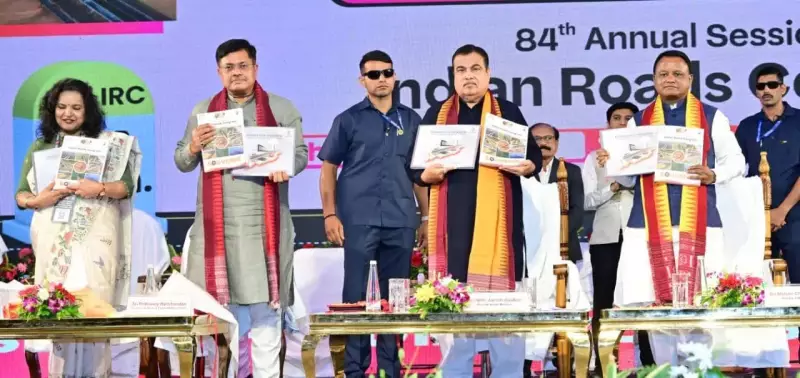
Bhubaneswar's Revolutionary Waste-to-Road Project
In a significant announcement that promises to address both infrastructure development and waste management challenges, Union Minister for Road Transport and Highways Nitin Gadkari revealed on Friday that the Centre will help Odisha utilize segregated municipal solid waste to construct the proposed ring road in Bhubaneswar.
Addressing delegates at the Indian Roads Congress (IRC) in Bhubaneswar, Gadkari shared that this innovative approach has already been successfully tested in Delhi and other locations across India. The minister confirmed that 80 lakh tonnes of municipal legacy waste has already been repurposed for road construction nationwide.
Transforming Waste into Sustainable Infrastructure
The newly sanctioned Bhubaneswar ring road project represents a major infrastructure milestone for Odisha's capital. Gadkari detailed that the ambitious six-lane access-controlled 'Capital Region Ring Road' will stretch 110.8 km and be constructed at a total cost of Rs 8,307.7 crore.

The project will be executed in three packages, with the groundbreaking ceremony scheduled to happen very soon. Completion is expected within two and a half years, promising significant relief from traffic congestion on NH-16 between Cuttack and Bhubaneswar.
"In Delhi, we successfully reduced waste from the Ghazipur dump yard by segregating garbage and using it for road construction. We will implement the same proven methodology in Bhubaneswar," Gadkari assured attendees.
Solving Bhubaneswar's Waste Management Crisis
This initiative comes at a crucial time for Bhubaneswar, which generates approximately 800 metric tonnes of garbage daily. Since the closure of the Bhuasuni dumping yard, the Bhubaneswar Municipal Corporation (BMC) has been storing collected waste at the temporary transit station (TTS) near Sainik School, processing it through micro composting centres and material recovery facilities.
A BMC official expressed optimism about the new approach: "If municipal waste is used for road construction, the massive waste accumulation near Sainik School will be substantially reduced. This will help us maintain urban cleanliness and eliminate the persistent stench issues at TTS."
Eco-Friendly Road Construction Innovations
Gadkari emphasized the broader environmental responsibility in infrastructure development, noting that the road sector contributes to approximately 40% of pollution in India. The minister outlined multiple eco-friendly practices being promoted nationwide.
The key sustainable approaches include:
- Using bamboo for constructing road barricades in Odisha, similar to implementations in northeastern states
- Generating bio-bitumen from rice straw, abundant in Odisha, providing additional income sources for farmers
- Utilizing steel slag and incorporating used tires into bitumen for road construction
- Focusing on import substitutes, cost-effective methods, and indigenous pollution-free techniques
"It is our fundamental responsibility to protect ecology and environment while developing infrastructure. We are committed to exploring various techniques that make road construction environmentally sustainable without compromising quality," Gadkari affirmed.
This integrated approach marks a significant step forward in sustainable urban development, addressing waste management challenges while building critical infrastructure for Bhubaneswar's future growth.






