

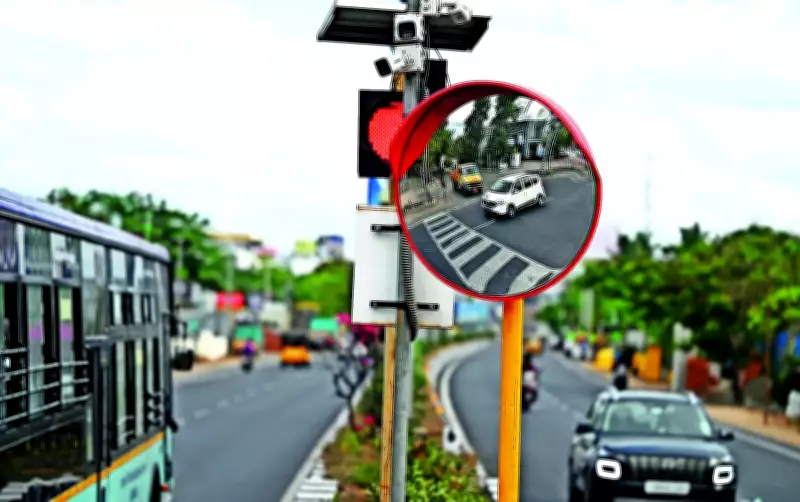
Chennai: Everyone who drives along Chennai's seaside corridor knows the risk. Enforcement cameras watch from poles, electronic boards flash vehicle speeds and patrol teams keep vigil. Yet fatalities continue to mount on ECR. Over the past 18 months, the 13-km corridor has recorded 17 deaths in 66 accidents.
Faced with that reality, the Tambaram police decided to begin not with another enforcement measure but by examining what was repeatedly triggering collisions. For that, traffic investigators brought in an expert group to study the entire 13-km section between Uthandi and Kovalam under their jurisdiction. Official records show that since last year, at least 14 pedestrians and 40 two-wheeler riders have died in crashes along this corridor. The four-lane national highway allows uninterrupted movement, with vehicles often maintaining 80kmph-120kmph after dark and, beyond the city limits near Mayajaal, even during daytime as traffic thins towards Puducherry.
After mapping crash locations and reviewing patterns across multiple locations, the study pointed to one recurring issue. Motorists travelling along the carriageway often fail to notice vehicles emerging from feeder roads, parallel lanes, resorts and eateries lining both sides of the route. As a result, a large share of incidents involved impacts from the side rather than direct frontal crashes more commonly associated with highways.

While several interventions were discussed, including surveillance expansion and modifications to connecting-road layouts, the review eventually settled on a simpler option. Convex mirrors.
At least 120 mirrors have been installed at 50 locations, including Akkarai, Panaiyur traffic signal, MGM near Muttukadu, Kanathur junction and Uthandi bus stop. At Kanathur junction, for instance, traffic from MGR Street and CLV Nagar Main Road joins the highway at acute angles. During nighttime, motorists moving along the highway often have little warning of vehicles entering from these roads. Mirrors positioned at both merging points now provide a clearer view of approaching traffic.
How Convex Mirrors Improve Safety
Unlike flat mirrors, convex mirrors provide a wide-angle view by reflecting a larger area within a single image. This allows drivers to spot oncoming vehicles, cyclists and pedestrians earlier, helping them make safer driving decisions, said Samai Singh Meena, deputy commissioner of police, Traffic, Tambaram.
Proven Success in Other Cities
Comparable measures have been adopted in cities such as Kolkata and Ahmedabad at busy intersections, flyovers and underpasses. Mountain regions including Dehradun, Haridwar and Nainital have long relied on such mirrors along winding stretches.
Additional Safety Measures Planned
The mirror project is also being paired with other measures. Police are planning pedestrian-operated crossing systems at locations witnessing significant foot movement. The arrangement enables pedestrians to activate a push button that briefly halts traffic in both directions, creating a 15-20 second window for safe crossing before vehicle movement resumes.
Stay updated with the latest Chennai news. Download the TOI App.






