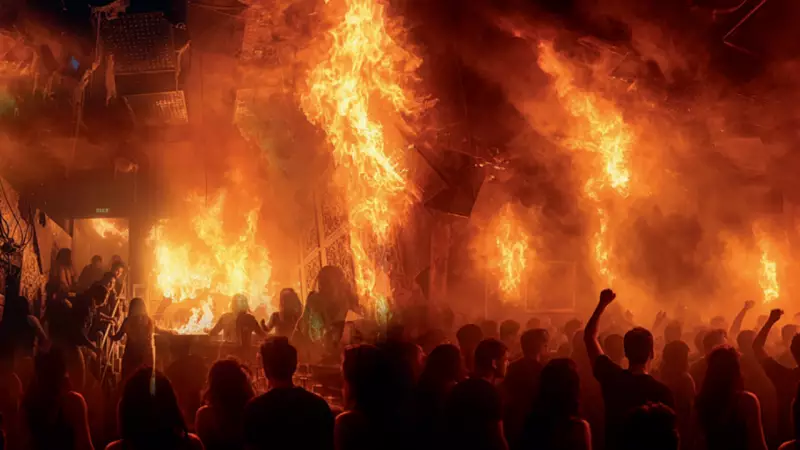
The tragic fire that claimed at least 25 lives at a nightclub in Goa on Sunday has ignited urgent questions about the state of fire safety in entertainment venues across India, including the national capital. Officials in Delhi admit that despite a robust regulatory framework, widespread non-compliance, dangerously crowded interiors, and neglected safety systems continue to endanger thousands of patrons nightly.
A Framework Exists, But Compliance is a Myth
A senior officer from the Delhi Fire Services (DFS) confirmed that the safety rules for nightclubs and bars are clearly defined. The regulations draw from the Delhi Fire Services Act, 2007, its 2010 rules, the National Building Code, 2016, and the Unified Building Bye-laws. "In theory, every club is supposed to comply with all of these," the officer stated. However, the reality on the ground tells a starkly different story.
Another officer detailed the basics that are routinely ignored. DFS inspections check firefighting arrangements, exit provisions, and equipment functionality before issuing a safety certificate, valid for three years. The fundamental gap, however, starts with the building layout. Venues are mandated to have at least two entry and exit points at opposite ends, but "this is hardly followed anywhere." Cramped designs featuring narrow staircases are common, while exit routes must be at least 1.5 metres wide with a clear height. Fire hydrants and extinguishers, when present, are often non-functional.

Hidden Hazards: Kitchens, Noise, and Darkness
The risks multiply in establishments serving alcohol, due to its high flammability. Station officer Nitin recalled a hazardous operation at M-Block in Connaught Place about three years ago, where claimed exits were blocked service entries. He highlighted the kitchen menace: "Most clubs don't have a separate kitchen. It is right next to the main dining space and they use LPG cylinders." He described a past incident where multiple cylinder explosions shook a concrete roof slab. Substandard electrical wiring and poor kitchen housekeeping compound these dangers.
Former Delhi Fire Services chief Atul Garg pointed out a unique, critical challenge. Even with functional alarms, the nightclub environment—deafening music, strobe lights, laser effects, smoke machines, and crowd density—muffles traditional alarm signals. "People inside often fail to perceive the alarm," Garg said, calling for specialized solutions beyond standard systems. A senior fire officer added that dim lighting, a staple of such venues, turns deadly in an emergency: "Once there is smoke, visibility drops to zero."
Systemic Checks and the Reality of Enforcement
Sandeep Anand Goyle, Delhi chapter head of the National Restaurants Association of India (NRAI), outlined the formal checks. The NRAI requires valid fire No-Objection Certificates (NOCs) for membership, which are also prerequisites for trade and liquor licenses for establishments over 90 square metres. "There is a clear system of checks and balances," Goyle explained. Yet, the admissions from fire officials reveal a chasm between paperwork and practical, daily safety. The combination of ignored layouts, hazardous material use, and environmental factors creates what one expert termed "a recipe for disaster," a risk horrifically realized in Goa and looming over venues in Delhi and beyond.