

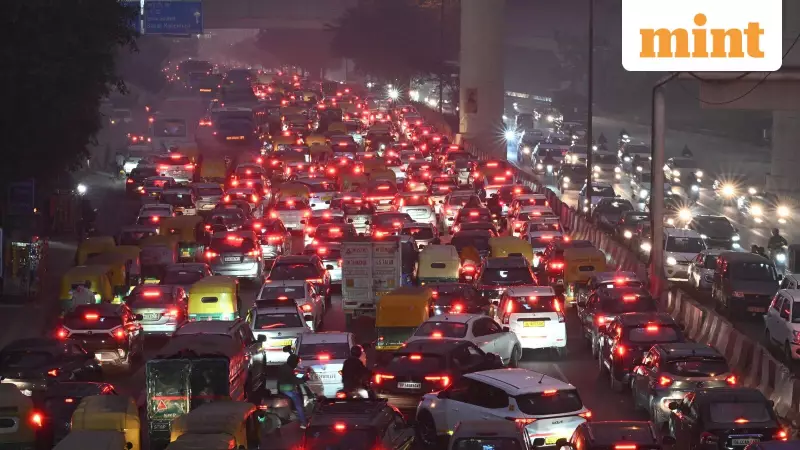
In a significant move aimed at tackling its chronic traffic gridlock and deteriorating air quality, the Delhi government is set to reintroduce app-based carpooling services on major ride-hailing platforms. According to sources familiar with the development, services like Uber, Ola, and Rapido could resume carpooling in the national capital by the end of January 2026.
Why Carpooling Was Banned in the First Place
The regulatory roadblock for app-based carpooling emerged back in 2019. The core issue stemmed from the type of permits under which taxi aggregators operate in Delhi. These are known as contract carriage permits, which legally allow a vehicle to be hired as a whole by a single passenger or group. They do not permit picking up multiple, unrelated passengers during a single trip.
Since the very model of carpooling involves picking up and dropping off different passengers along a route, transport authorities deemed that such services fell outside the scope of these permits. Karun Mehta, partner at Khaitan & Co., explained that aggregators offering carpooling were consequently considered ineligible for contract carriage licences.

Legal experts, however, clarify that the problem was more about a regulatory gap than an outright ban. Tushar Agarwal, founder of C.L.A.P. Juris Advocates & Solicitors, pointed out that genuine cost-sharing by private vehicle owners, without a profit motive, does not convert a private car into a commercial service. The friction arose from the lack of a clear state-level framework to govern commercial pooling features on ride-hailing apps.
The Executive Path to Revival
The suspension was enforced through an executive order, and the same mechanism is now being used to reverse it. Karun Mehta noted that a new scheme can be introduced by an executive order to supersede the existing one, thereby reviving carpooling in Delhi.
This time, the service will be classified as a non-commercial shared mobility option. Aggregators have been asked to rebuild their in-app pooling features, a process that requires significant technical effort. This includes fresh app integrations, backend changes to support ride-matching for concurrent trips, and recalibrating operations around routing, pricing, and driver incentives.
Additionally, the government has urged platforms to expand bus and shuttle services, especially on office routes and high-demand corridors, to alleviate peak-hour pressure on roads.
A Desperate Need: Cutting Congestion and Emissions
The push to restart carpooling is driven by Delhi's escalating twin crises of traffic congestion and air pollution. Unlike seasonal factors like stubble burning, vehicular emissions are a persistent, year-round contributor to the city's toxic air.
Studies over the past decade highlight the severity of the problem. A 2015 IIT Kanpur study estimated that transport contributed to about 20% of Delhi's annual PM2.5 pollution. Later assessments painted a grimmer picture: a 2018 study by TERI and ARAI put the share at 39%, while SAFAR's assessment estimated it at 41%.
The government views shared mobility as a crucial tool to reduce private vehicle usage and better utilize existing road capacity.
Will It Make a Real Difference?
While the revival of carpooling is a step towards shared mobility, experts caution that its environmental and congestion benefits are not automatic. The net gain depends heavily on implementation.
Amit Bhatt, managing director (India) at the International Council on Clean Transportation, issued a critical warning. He emphasized that any push for carpooling must not come at the expense of public transport. If shared rides end up pulling commuters away from buses and the metro, the overall environmental gains could be diluted instead of amplified.
Bhatt reiterated that public transport remains vastly more affordable and climate-efficient than cab-based travel, whether shared or single-occupancy. The success of carpooling will be measured by how well it complements, rather than competes with, Delhi's backbone metro and bus networks.

As the city holds its breath for cleaner air and smoother commutes, the return of app-based carpooling marks a policy experiment with high stakes. Its impact on Delhi's infamous winter smog and daily traffic snarls will be closely watched in the months to come.





