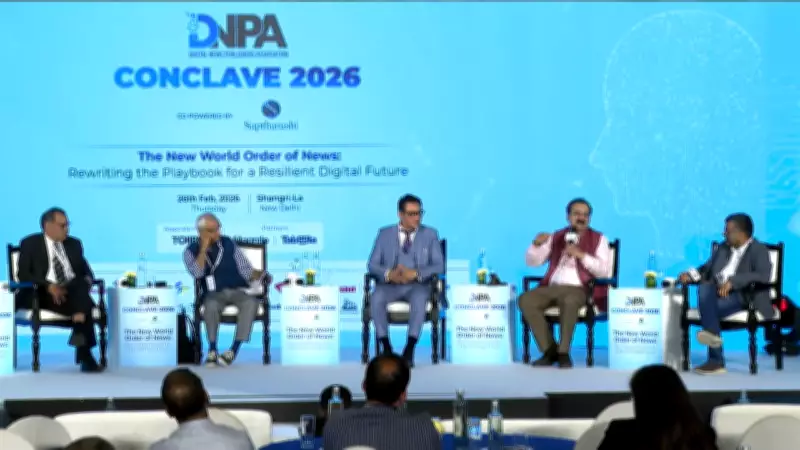
DNPA Conclave 2026 Sparks Debate on Media Regulation's Dual Role
The fourth Digital News Publishers Association (DNPA) Conclave 2026 brought together prominent industry leaders and policy experts to engage in a critical discussion on the current regulatory environment in India. The focus was on analyzing the profound impact regulations are having on the media industry and publishers, with diverse perspectives emerging on whether these rules serve as obstacles or essential frameworks for survival and growth.
Regulation as a Hurdle or Enabler: Divergent Views from Experts
Rajnish Gupta, Partner and Leader of Economic Policy at EY India, addressed the central question of whether regulatory conditions act as barriers or mechanisms for publisher sustainability. He emphasized that the outcome of every policy varies depending on one's perspective, stating, "It depends on the lens you're looking at it." Gupta highlighted the evolving nature of the regulatory space, noting it is not static. He provided examples: "If you're a platform, you might not like the guidelines targeting intermediaries. Conversely, from the viewpoint of digital media, in an era dominated by AI and deepfakes, the credibility, research, and authenticity of work are increasingly questioned."
Policy as an Innovation Catalyst in India's Digital Landscape
Shivnath Thukral, Vice President of Public Policy and Government Affairs at PhonePe and former Public Policy VP at Meta, shared insights from his journey across different media platforms. He expressed that policy has largely been an enabler, stating, "I can hardly complain that policy hasn't been an enabler." Thukral pointed to India's success in attracting major platforms like Facebook and Google, which have their largest market bases in the country. He attributed this to supportive regulatory frameworks, saying, "There must be a reason why RBI is working towards policy enabling with the Government of India's support. India boasts the largest digital payment ecosystem." He concluded with a key observation: "Regulation follows innovation. The regulation in the digital ecosystem, including digital media, has created significant space for innovation."

The Necessity of Regulation for Economic Stability and Fundamental Rights
Supreme Court lawyer Vivek Narayan Sharma asserted the indispensable role of regulation in maintaining a robust economy. He stated unequivocally, "There is no question of operating without regulation; for a good and stable economy, regulations must be in place. If they are absent, everything will go haywire, everyone will act arbitrarily, and there will be no control." Sharma also addressed the delicate balance of regulatory control, emphasizing that it should be exercised with reference to the fundamental rights enshrined in the Constitution. He explained, "Control should be measured against the barometer of constitutional rights. Regulation should have a clear purpose, enabling people to operate their businesses effectively, making these regulations critically important."
Inadequate Regulations and the Call for Proactive Compliance
Adding a contrasting perspective, Pavan Duggal, Founder and Chairman of the International Commission on Cyber Security Law, urged stakeholders not to wait for regulations. He criticized the current regulatory framework, saying, "Current regulations are neither adequate, nor sufficient, nor can be termed as over-regulations." Duggal specifically commented on the newly introduced rules by the Centre aimed at countering AI-generated content, warning, "These are not going to be enough. If you think this marks the end of rules on the subject, it surely does not. We need to ensure we are actually complying with the already existing rules."

Conclusion: A Complex Regulatory Landscape Shaping Media's Future
The discussions at the DNPA Conclave 2026 revealed a multifaceted view of India's regulatory environment. While some experts see regulations as essential for fostering innovation and economic stability, others highlight gaps and call for more robust frameworks. The debate underscores the ongoing challenges in balancing control with freedom, ensuring credibility in the age of AI, and adapting to rapid technological changes. As the media industry continues to evolve, these regulatory dialogues will play a pivotal role in shaping its trajectory in the coming years.