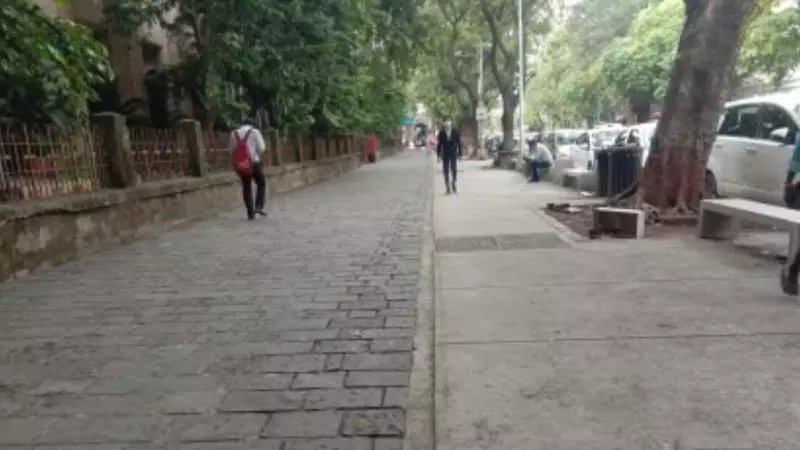
In the midst of heated political debates, the crumbling state of our urban infrastructure often gets sidelined. Yet, the politics of our society is inextricably linked to the architecture of our cities. To grasp this connection, one must look no further than the humble footpath. The condition of our sidewalks is a direct reflection of who we value as citizens.
The Footpath as a Measure of Citizenship
Walking is far more than a mode of transport. It is the process through which individuals inscribe themselves into the city's narrative. The design of our streets performs a silent but powerful act of exclusion. When cities lack proper footpaths, forcing those without cars into dangerous traffic, they send a clear message: some lives are considered expendable.
Official planning documents, like the Delhi Master Plan 2041, eloquently describe visions of walkable neighborhoods, shaded streets, and seamless pedestrian pathways. They promise a future of compact, people-friendly metropolises. However, on the ground, walking remains an afterthought. Footpaths are treated as residual strips of land, allocated only after space for vehicles is secured.

This bureaucratic mindset reduces walking to mere "last-mile connectivity," transforming the pedestrian from a citizen with rights into a logistical hurdle to be solved. For countless Indians—the domestic worker trekking from a bus stop, the student navigating neighborhoods to reach the metro, the street vendor on their daily rounds—walking is not a choice but a daily negotiation with risk and indignity.
Walking as Political and Philosophical Act
Thinkers and writers have long recognized the profound significance of walking. Virginia Woolf saw it as a way to find mental space. Walter Benjamin celebrated the flâneur, the observant wanderer who deciphers the city's rhythms. Yet, this ideal of leisurely strolling presupposes safety and anonymity, a privilege not afforded to all.
Scholar Garnette Cadogan, in his essay Walking While Black, details the constant self-policing required in American cities to avoid suspicion. Similarly, in India, the pavement can be a perilous teacher. The act of walking exposes the city's most violent social hierarchies, making its inequalities starkly visible to those who move at a human pace.
History is replete with walks that became powerful political statements. B.R. Ambedkar's marches, like the procession to the Mahad tank, were spatial challenges to caste exclusion, demanding Dalit access to public spaces. Mahatma Gandhi's Salt March transformed rural roads into a stage for anti-colonial resistance. Martin Luther King Jr.'s civil rights marches turned walking into a collective promise and warning. The street, therefore, is the ultimate political forum, and walking is a form of speech.
The Ethical Width of a Sidewalk
The dimensions of a footpath are an ethical gauge. This slender strip of public realm is primarily used by society's least powerful. A walking body is vulnerable, unprotected by metal or wealth, exposed to speeding vehicles, pollution, and societal contempt. A society that cannot dedicate a few continuous, safe meters for pedestrians reveals a fundamental flaw in its moral compass.
The sidewalk is also where civic empathy is cultivated. Walking places everyone on the same level—shoulder to shoulder. It necessitates small, considerate acts: slowing down for an elder, making way for another. These micro-negotiations foster an everyday ethics, a habit of recognizing and accommodating the vulnerability of others.
Conversely, when footpaths are encroached upon or shrunk to slivers, empathy is literally designed out of the public sphere. The failure of Indian cities to provide basic pedestrian infrastructure is thus not merely a technical shortcoming but a profound moral failing.

Footpaths are the backbone of urban democracy. To demand safe, continuous, and shaded sidewalks is to assert a non-negotiable public right. Walking is not the "last mile" of a journey; it is the first right of a citizen in a city. Until these pathways materialize under our feet and not just in master plans, the walkers of Indian cities will remain its most neglected citizens. The politics of exclusion and neglect is built into our urban fabric. To forge a politics of empathy and coexistence, perhaps we all need to start walking more.