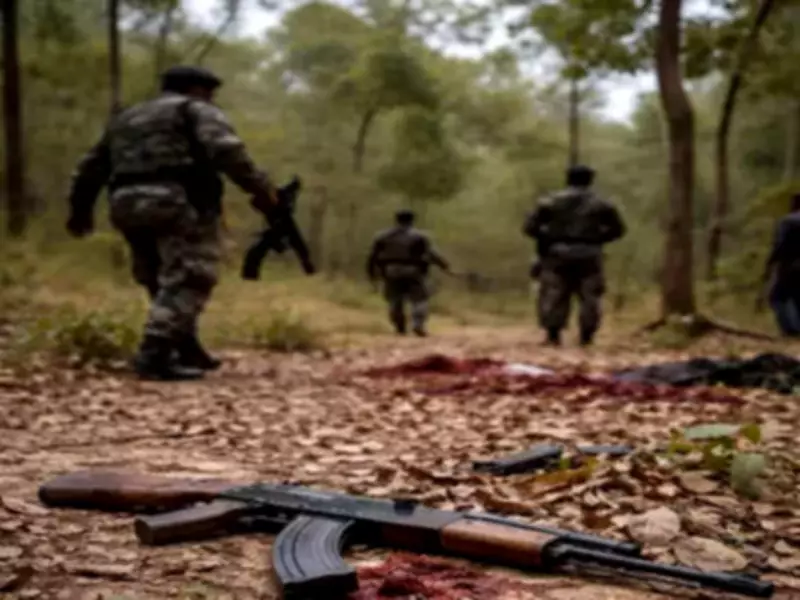
RAIPUR: For years, Pradeep Kunjam carried an assault rifle through the forests of Bastar. Today, he carries something else in his arms — his eight-month-old daughter Karishma. The former Maoist, who spent over a decade in the insurgency, says becoming a father was once unimaginable.
From Insurgency to Parenthood
"I thought I had given up that part of life forever," he says, smiling as his daughter tugs at his shirt. Kunjam is among a growing number of surrendered Maoist cadres in Bastar who have undergone reverse vasectomy surgeries after returning to the mainstream.
The initiative, backed by Bastar Police, district administrations, and medical teams, saw a batch of 30-33 male cadres undergo reverse vasectomy procedures at Jagdalpur's Maharani Hospital in May and June. This marks the first batch to opt for the surgery after the Centre's March 31 deadline for eliminating armed cadres.

The Personal Cost of Insurgency
The programme addresses a deeply personal consequence of life inside the Maoist movement. Former cadres revealed that those seeking to marry within the insurgent ranks were often required to undergo vasectomy, as having children was seen as a distraction from the cause. This mandate was enforced to ensure undivided loyalty to the movement.
Surrendered cadres have repeatedly recounted similar experiences after returning to civilian life. For many, the decision to undergo vasectomy was made in their late teens or early twenties, without fully understanding the long-term implications.
A Second Chance at Family Life
Years later, after surrendering and attempting to rebuild their lives, the same men found themselves confronting a different reality — the desire for a family. "Many surrendered cadres told us they wanted to become parents and live normal family lives," said Bastar range inspector general of police P Sundarraj. "Rehabilitation is not only about livelihood and security. It is also about restoring dignity, family and social acceptance."
Medical Challenges of Reversal
The surgery itself is far from simple. Known medically as vasovasostomy, reverse vasectomy is a specialised microsurgical procedure that reconnects the severed vas deferens, allowing sperm to once again enter the semen. Doctors said success depends on several factors, including the method used during the original vasectomy, the length of time since the procedure, and the extent of tissue damage.
At Jagdalpur's Maharani Hospital, teams of urologists and microsurgery specialists from across the country volunteered their services for the camps. "The procedure requires precision under high-powered microscopes," said one of the participating surgeons. "In some cases, the original vasectomy appears to have been performed in difficult field conditions. That makes reconstruction more challenging."
Medical experts estimate that the chances of successful reversal generally range between 30% and 70%, depending on individual circumstances. Even after successful surgery, pregnancy is not guaranteed and may take months or years.
Success Stories Bring Hope
Of the 26 surgeries that took place in past years since 2007, only twelve couples have successfully conceived and subsequently become fathers, according to government data. These families are now living normal lives.
Among them is Dinesh Kadti, a former Maoist deputy commander who surrendered in 2012. He recalled watching village children play and realising what he had sacrificed. "I used to think I would die in the jungle," he said. "Then I started wondering what life would be like if I had a son or daughter. That feeling never left me." Today, his five-year-old son runs around the courtyard of his home in Dantewada.
For another former cadre, Yogesh Madvi, fatherhood has become a marker of a life reclaimed. A former regional committee member who once worked alongside senior Maoist leaders, Madvi says the birth of his son gave him a sense of peace that years in the insurgency never did. "When I look at him, I feel life gave me a second chance," he says.

Expanding the Programme
The reverse vasectomy programme is now being expanded as more surrendered cadres come forward. Officials estimate that over 100 former Maoists may eventually seek the procedure. At a time when security forces often measure success in terms of encounters, arrests and surrenders, the scenes unfolding at Maharani Hospital tell a different story.
In one ward, men who once spent years navigating minefields and carrying weapons wait anxiously for doctors. Their concerns are no longer about operations in the jungle, but about whether they will someday hear a child call them father. For Bastar, a region that has spent decades caught between violence and counter-insurgency, that transition may be among the most remarkable transformations of all.