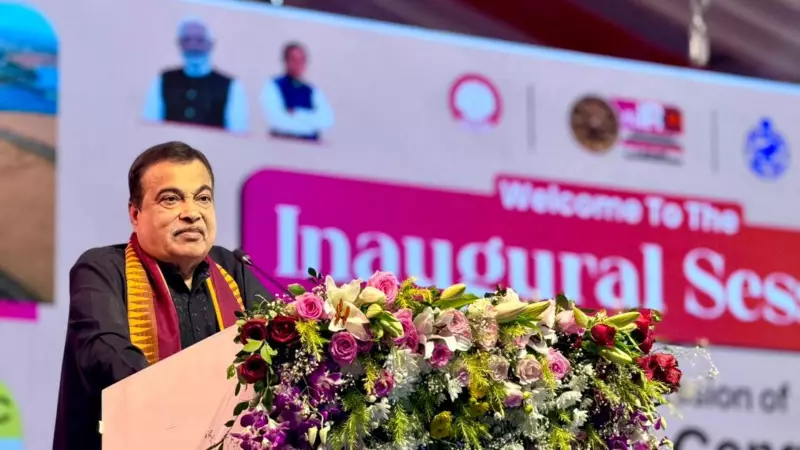
Union Road Transport and Highways Minister Nitin Gadkari delivered a powerful message to the engineering community on Friday, emphasizing the critical need for innovation and experimentation in India's road infrastructure development. Addressing the 84th edition of the Indian Roads Congress in Bhubaneswar, the minister outlined his vision for transforming India's road network through technological advancement and progressive thinking.
Embracing Failure as Part of Innovation
In a significant departure from conventional government practices, Gadkari advocated for a more forgiving approach toward failed experiments. "In the government system, when something new is experimented with and fails, senior officers order action against those who initiated the experiments," he observed. However, the minister strongly recommended changing this mindset, stating that new experiments are essential for progress and innovation.
Gadkari proposed a balanced approach to handling experimental failures: "If the mistakes are bonafide, forgive them. If the mistakes are malafide, then take action against them." This distinction between genuine attempts at innovation and intentional wrongdoing marks a significant shift in how government projects might be evaluated in the future.

Global Standards and Best Practices
The minister challenged engineers and researchers to think beyond traditional methods, posing crucial questions: "How will change come? How will you accept the best practices adopted globally?" His message underscored the importance of learning from international successes while developing indigenous solutions.
Gadkari specifically appealed to professionals to develop and implement new codes, standards, guidelines, and design practices that align with global benchmarks. He recognized the Indian Roads Congress as the knowledge platform that has been preparing these standards for road engineering over the past nine decades, but emphasized the need for continuous updating and improvement.
Transparent and Expedited Decision-Making
For achieving qualitative transformation in road engineering, the minister stressed the importance of constant research combined with expeditious decision-making in a transparent manner. He highlighted that along with transparency, quality commitment and fast-track decision making, necessary changes in the administrative system are equally crucial for pushing infrastructure growth.
"To take India forward, we want to implement new practices and successful experiments," Gadkari declared, outlining the government's forward-looking approach to infrastructure development.
Sustainability and Safety Focus
The minister also highlighted the government's commitment to road safety, focusing on advanced engineering standards, intelligent transport systems, and awareness initiatives to ensure safer and more efficient mobility for all citizens.
On environmental sustainability, Gadkari noted significant progress in using bio-bitumen and recycled plastic waste in highway construction, which has enhanced durability, sustainability, and cost-efficiency. He also highlighted India's remarkable transition from a fuel-importing to a fuel-exporting country, driven by the production of ethanol, methanol, bio-LNG, green hydrogen, and CNG.
The minister's address at the Indian Roads Congress signals a new era for India's infrastructure development, one that embraces innovation, tolerates calculated risks, and prioritizes sustainable growth through technological advancement and global collaboration.