

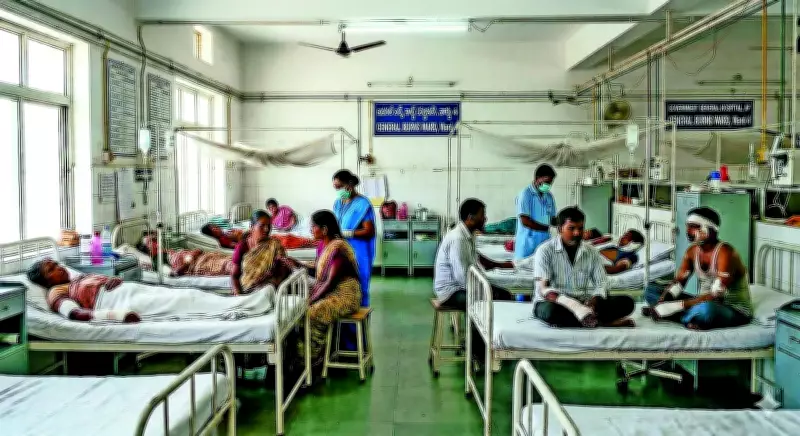
Hyderabad: For many patients in Telangana, treatment at a government hospital may be free, but the journey to recovery often comes at a significant cost. A patient from a village traveling to Hyderabad for treatment at a major government hospital may not pay for consultation, but expenses for transport, food, medicines purchased outside the hospital, and diagnostic tests quickly add up. By the end of a single visit, a family may end up spending over ₹1,500 to ₹2,000. A follow-up visit a few weeks later means incurring the same expense all over again.
This hidden financial burden continues to affect households across Telangana, according to the latest National Health Accounts (NHA) report for 2022-23. The report shows that families' monthly out-of-pocket expenditure (OOPE) on healthcare increased from ₹2,447 in 2021-22 to ₹2,697 in 2022-23, despite the Aarogyasri scheme providing free financial support for hospitalization and major procedures. Still, patients often continue to bear the cost of medicines, blood tests, scans, travel, and follow-up consultations. At the same time, the state government's health spending declined during the same period, from ₹3,007 to ₹2,814.
D Suresh, whose father is undergoing treatment at a government hospital in Ameerpet, said the family spends nearly ₹3,000 every month despite receiving support under Aarogyasri. “The treatment is covered, but we still spend on travel, unavailable medicines, tests, and repeat visits to the hospital. These expenses keep adding up every month,” he said. Similarly, M Laxmi, a resident of Nalgonda district whose husband is receiving treatment for diabetes and heart-related complications, said regular healthcare costs have become a major burden. “We travel to Hyderabad almost every month. Bus tickets for the two of us cost around ₹700 for a round trip. Medicines that are not available at the hospital cost another ₹1,000-1,200, while blood tests and scans can cost anywhere from ₹500 upwards. Even when the treatment itself is free, we end up spending nearly ₹2,500-3,000 every month. There are many other expenses that families like ours have to manage,” she added.

The 2025 Rajya Sabha Standing Committee also pointed out that medicine pricing remains poorly regulated, with pharmaceutical companies determining the Price to Retailer (PTR), leading to wide price variations and increasing costs for patients. Health experts highlighted that the problem lies in recurring outpatient expenses, which are often not covered under insurance schemes.
Dr D Srinath, president of the Telangana Senior Doctors Association (TSRDA), said that although Aarogyasri and many insurance schemes offer cashless treatment, patients still have to pay for basic items such as gloves, syringes, IV sets, and other medical consumables. “Insurance companies usually classify these as ‘non-payable items’ and do not include them in the package. Post-treatment support is also limited. Under Aarogyasri, coverage often ends within 10 days of discharge. After that, patients must pay for follow-up check-ups, tests, medicines, and long-term treatment. Because of these gaps, many families continue to spend heavily on healthcare even when they have cashless insurance coverage,” Dr Srinath explained.
Dr Kiran Madhala, secretary-general of the Telangana Teaching Doctors Association (TTGDA), said that nearly 90% of out-of-pocket health spending in India goes towards medicines and diagnostic tests, with the burden being higher in states such as Telangana. “Patients with diabetes, hypertension, kidney disease, and cancer require regular follow-up visits, medicines, blood tests, and travel. For many families, these recurring outpatient costs become a greater financial burden than a single hospitalization,” he said. Experts emphasized the need for stronger primary healthcare services and government-supported clinics for diabetes, hypertension, and other lifestyle diseases to reduce the long-term financial burden on families.

A senior health official said that while OOPE remains a concern, the government is continuously working to reduce the financial burden on patients. “Based on the hub-and-spoke model, we have started free dialysis and cancer care centers in districts so that patients do not have to travel. Similarly, we are planning to establish referral hospitals,” the official said. The proposed centers are likely to come up across the erstwhile 10 districts, including Adilabad, Nizamabad, Karimnagar, Warangal, and Medak, and will function as advanced referral hubs for surrounding district and area hospitals. “The initiative aims to reduce the steady flow of referrals to Hyderabad, where premier government hospitals face heavy patient loads and long waiting times. By strengthening district-level infrastructure, the government hopes to minimize travel hardship for patients and reduce delays in treatment. It will also rationalize spending under the Aarogyasri Health Care Trust by reducing reliance on private hospitals,” the official added.





