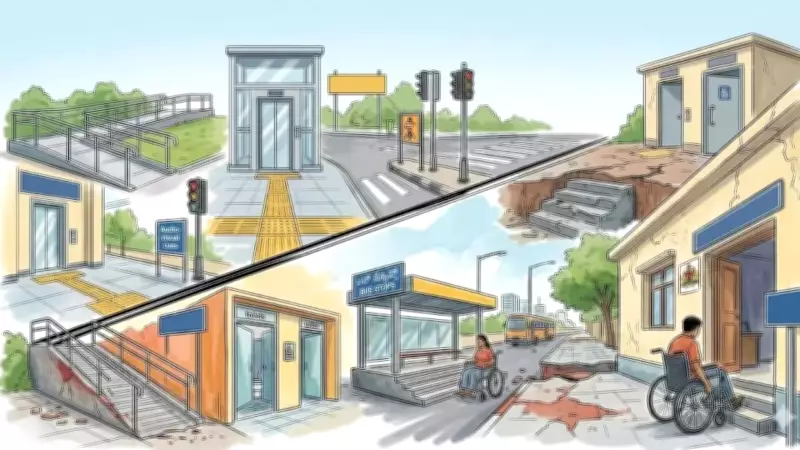
Statewide Audit Uncovers Widespread Accessibility Failures in Karnataka
A comprehensive accessibility audit conducted across Karnataka has revealed that public spaces, including ramps, toilets, parking areas, and tactile pathways, remain largely unusable for persons with disabilities. The findings highlight a persistent exclusionary environment, forcing individuals to navigate daily challenges that hinder their mobility and independence.
Daily Struggles of Commuters with Disabilities
Devaraj KM, a 43-year-old accountant with the Association for People with Disabilities in Bengaluru, exemplifies these hardships. Living with polio since childhood, he relies on KSRTC buses for his 60km commute from Chintamani. "Most buses are high-floor, and I often stand throughout the journey as people ignore my requests for seats," he explains. Conductors rarely intervene, compounding his difficulties.
Beyond transportation, broken pavements pose significant barriers. "Footpaths are barely accessible, with missing ramps and misplaced slabs exposing drains," Devaraj adds. His experiences are echoed in the Sugamya Yatra audit, which assessed over 1.8 lakh locations statewide.

Audit Findings: A Stark Picture of Inaccessibility
The audit uncovered alarming statistics:
- Only 3,946 out of nearly 1.2 lakh locations had accessible parking spaces, a mere 3.3%.
- Ramps were present at 74,840 of 89,564 locations, but many were poorly designed or non-functional.
- Wheelchairs were available at just 8,164 of 59,025 locations.
- Tactile pathways were found in only a fraction of internal routes.
- Of 32,507 toilets, 8,788 were Western-style, with gender-neutral facilities often lacking separate options for men and women.
In Bengaluru Urban alone, accessibility gaps were flagged at 7,636 locations. While around 80% of Metro stations had signage for parking accessibility, the absence of tactile pathways and approach-route signage at most sites complicates navigation.
Personal Accounts Highlight Broader Issues
Ashmira, a 35-year-old visually impaired individual, notes that the cost of navigation extends beyond inconvenience. "In Bengaluru, using public transport is almost impossible, forcing reliance on expensive autos," she says. Walking poses risks, with vehicles coming dangerously close without audible cues.
Arbeena Kausar, 25, who has dwarfism, recalls barriers from school days. "Boarding BMTC buses is tough due to high floors and limited ramp access. Even low-floor buses have challenges, and escalators are daunting," she emphasizes. She advocates for gender-segregated toilets, as current gender-neutral facilities fail to meet specific needs.
Government Response and Advocacy Efforts
Manmeet Nanda, additional secretary of the department of empowerment of persons with disabilities, stated that the audit aimed to capture these everyday obstacles. "You don't realize these small things until they're documented," she remarked. Based on the findings, the government has sought a budget to address gaps, with APD projecting a requirement of Rs 396 crore.
Bhumika Modh, APD's policy advocacy head, acknowledged that while accessibility gaps persist across states, Karnataka's effort to quantify them is notable. The audit shows some progress in entrances and toilets, but for persons with disabilities, accessibility is measured in practical terms—like boarding a bus or walking safely—rather than percentages or financial allocations.
This audit underscores the urgent need for actionable improvements to ensure inclusivity and equal access for all citizens in Karnataka.