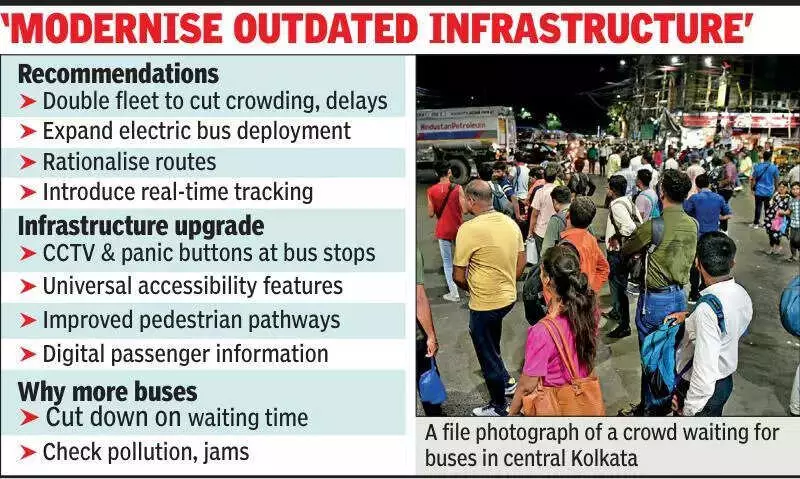
Kolkata's public bus system is teetering on the brink of a catastrophic collapse, with its operational fleet witnessing a drastic reduction that has crippled daily commute for millions. From a robust strength of approximately 6,000 buses, the number has alarmingly dwindled to fewer than 2,000 vehicles, triggering what experts are calling the worst service crisis in the city's history.
A City Left Waiting: The Cascading Effects of Fleet Shortage
This severe contraction has led to an unnatural and frustrating spike in waiting times for commuters. Where buses once arrived every 5 minutes, passengers across large swathes of the city now wait nearly 20 minutes on average. In several pockets, especially during peak hours, waiting times have ballooned to a staggering 30 to 40 minutes. This unreliable service has eroded public confidence, pushing a significant number of people towards private two-wheelers and auto-rickshaws, thereby increasing congestion and pollution.
"Operators are withdrawing services due to financial uncertainty and poor return on investment," explained Aniket Banerjee of the Kolkata Bus-o-Pedia Foundation. Anupam Roy from the SwitchON Foundation added a crucial point: "Even after losing passengers to two-wheelers and autos, buses still carry the largest share of daily riders. But the system is now stretched to its breaking point."

Multi-Stakeholder Consultation Calls for Comprehensive Overhaul
Amid this growing mobility emergency, transport experts, civil society groups, researchers, and government representatives convened for a critical multi-stakeholder consultation. The meeting, organised by the Kolkata Bus-o-Pedia Foundation and SwitchON Foundation on November 29 at Rotary Sadan, resulted in a unanimous and urgent appeal: the immediate doubling of Kolkata's bus fleet to restore basic service levels.
The consensus was that a mere numerical increase is insufficient without a complete systemic overhaul. The key recommendations put forward include:
- Route Rationalisation: Streamlining and optimising bus routes based on current passenger demand and travel patterns.
- Fleet Electrification: A major expansion of Kolkata's electric bus fleet to promote low-emission, sustainable mobility.
- Technology Integration: Implementing real-time tracking, digital fleet management, open mobility data, and automated, data-driven scheduling.
- Seamless Multi-Modal Integration: Improving connectivity links between buses, the Metro, suburban rail, ferries, and autos for smoother last-mile journeys.
Modernising Infrastructure for a Sustainable Future
Stakeholders emphasised that modernising the city's outdated transport infrastructure is equally vital. The proposed upgrades focus on enhancing commuter safety, accessibility, and experience:
- Renovating bus stops and passenger shelters with better amenities.
- Installing CCTV cameras, panic buttons, and improved lighting for security.
- Incorporating universal accessibility features for persons with disabilities.
- Upgrading pedestrian pathways and major interchange hubs.
- Setting up digital passenger information boards for real-time service updates.
Representing the operators' challenges, Titu Saha, secretary of the City Suburban Bus Service, stated, "We have been struggling to stay afloat every single day. A lot of rejig is required but operators and passengers must be central to this course of action." He cautioned against top-down approaches that have led to the failure of past government initiatives.
Experts from the West Bengal Transport Corporation (WBTC) stressed that a renewed and expanded bus system is key to pulling commuters away from private vehicles, which would directly lead to lower emissions and cleaner air for Kolkata.

The consultation concluded with a resolve to develop a coordinated action plan. Summarising the imperative for change, Sudipto De, a professor from Jadavpur University, said, "With a growing population, limited resources, and emerging technologies, the city's transport system must adapt dynamically. A sustainable transport model must optimise economy, environment, and social acceptance — backed by strong innovations and a clear understanding of commuter needs." The call to action is clear: Kolkata must double its buses and reinvent its public transport network to avoid a complete mobility breakdown.