

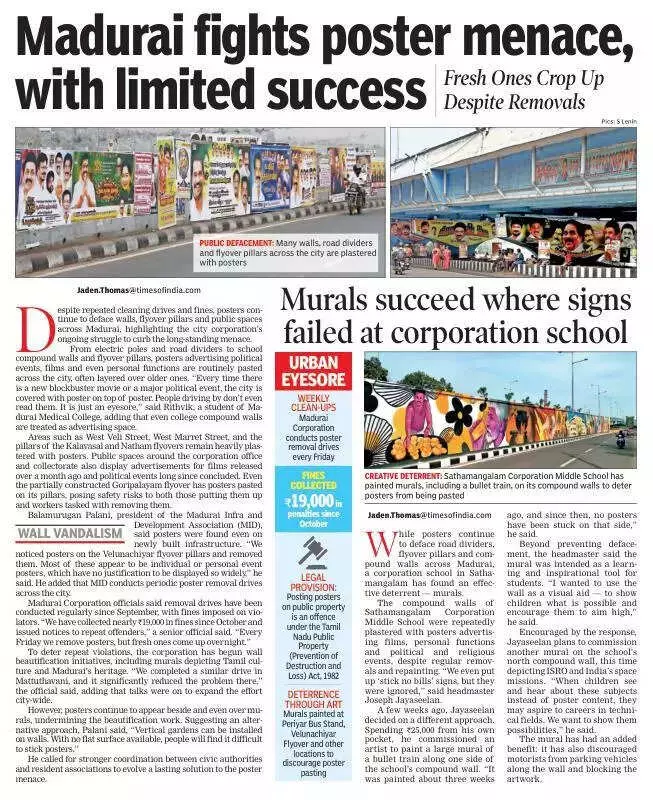
Despite consistent enforcement actions and financial penalties, the ancient city of Madurai continues to wage a frustrating battle against the rampant defacement of its public spaces by unauthorized posters and advertisements. From political rallies to film promotions, these visual pollutants are plastered across walls, flyover pillars, and even educational institutions, creating a persistent urban eyesore.
A City Plastered in Layers
The scale of the problem is evident in every corner of the city. Locations like West Veli Street, West Marret Street, and the pillars of the Kalavasal and Natham flyovers remain chronically covered. The issue is not limited to older structures; even newly built infrastructure like the Velunachiyar flyover and the partially constructed Goripalayam flyover are not spared. This poses significant safety risks to both the individuals illegally pasting the ads and the workers assigned to remove them from hazardous heights.
Rithvik, a student of Madurai Medical College, voiced a common frustration, noting that college compound walls are routinely treated as free advertising space. "Every time there is a new blockbuster movie or a major political event, the city is covered with poster on top of poster. People driving by don't even read them. It is just an eyesore," he said. The problem is compounded by outdated ads, with public spaces near the corporation office and collectorate still displaying promotions for films released over a month ago and long-concluded political events.

Enforcement Efforts and Their Limits
Madurai Corporation officials have been actively trying to combat the menace. Weekly clean-up drives are conducted every Friday, and a legal framework is in place. Posting on public property is an offence under the Tamil Nadu Public Property (Prevention of Destruction and Loss) Act, 1982. Since October, the corporation has collected nearly ₹19,000 in fines and issued notices to repeat offenders.
However, the challenge is relentless. "We have collected nearly ₹19,000 in fines since October and issued notices to repeat offenders," a senior official stated. "Every Friday we remove posters, but fresh ones come up overnight." This highlights the cyclical nature of the problem, where punitive measures alone are insufficient to deter violators.
Seeking Creative and Collaborative Solutions
In response, the civic body has initiated a more creative deterrent: wall beautification. By painting murals depicting Tamil culture and Madurai's heritage at locations like the Periyar Bus Stand and Velunachiyar Flyover, officials aim to discourage people from defacing artistic work. A pilot project in Mattuthavani showed promising results, leading to talks about expanding the initiative city-wide. Sadly, posters have already begun appearing beside and even over these new murals, undermining the effort.
Balamurugan Palani, president of the Madurai Infra and Development Association (MID), which conducts its own periodic removal drives, suggests an alternative. "Vertical gardens can be installed on walls. With no flat surface available, people will find it difficult to stick posters," he proposed. Palani emphasized that many offending posters are for individual or personal events with no justification for such widespread display. He called for stronger coordination between civic authorities and resident associations to evolve a lasting, community-driven solution to this chronic urban issue.
The struggle in Madurai underscores a common urban management dilemma: balancing civic cleanliness with the informal demand for advertising space. While fines and clean-ups address the symptom, a sustainable fix may lie in a combination of beautification, structural deterrence like vertical gardens, and robust community engagement.






