

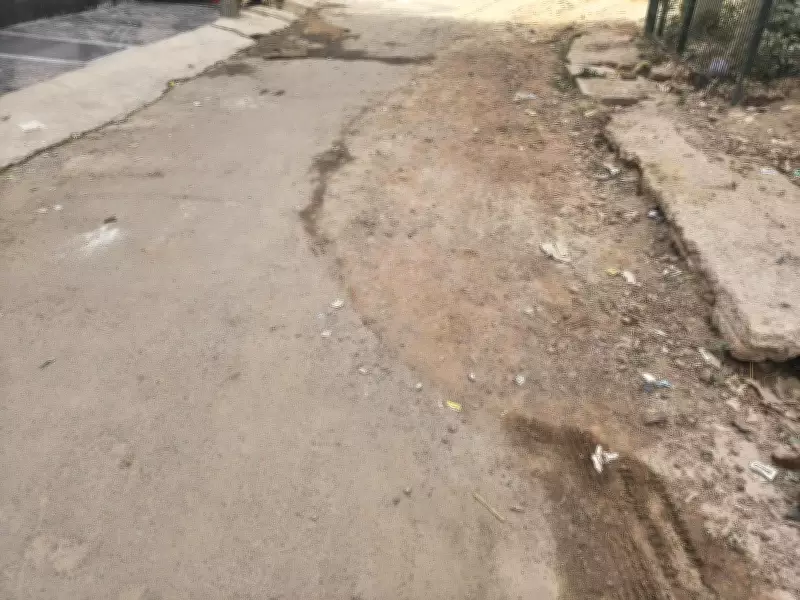
The Municipal Corporation of Gurgaon (MCG) is grappling with a significant backlog of road-related grievances, ranging from pothole-ridden streets and damaged patches to delayed repairs and substandard restoration work. According to the latest Mhari Sadak daily status report as of June 8, the civic body has received a total of 2,849 complaints. Of these, 861 complaints, accounting for 30.2 percent, are currently marked as “in process,” while 1,984 complaints, or 69.6 percent, have been closed. Notably, 238 of the in-process complaints, referred to as active, have already exceeded their prescribed deadlines.
Residents Voice Concerns Over Poor Quality Repairs
The Haryana government’s Mhari Sadak portal enables residents to report potholes, damaged roads, and other infrastructure defects while tracking the progress of their complaints. Two cases, filed directly with the MCG in Sector 23A and Sector 9A, highlight a broader pattern emerging from the portal, indicating that these are not isolated issues.
Sector 23A: Incomplete and Deteriorating Work
In Sector 23A, a private contractor hired by the MCG to repair internal roads at an estimated cost of Rs 1.3 crore allegedly completed only about 60 percent of the work in May last year. Residents claim that even the stretches that were repaired have already begun to crumble, with potholes and damaged patches reappearing. The project was scheduled to run from February to May 2025, but residents say work only started in May and has remained incomplete since then.

Sector 9A: Six-Month Wait for Road Repair
A few kilometers away in Sector 9A, residents have spent the last six months waiting for a road to be repaired after sewer work left a stretch between the ESI Hospital and the pumping station in a damaged condition. Despite repeated complaints since January regarding what residents describe as poor restoration work, no corrective action has been taken so far.
Residents Seek Intervention from MCG Officials
In both cases, residents said they repeatedly approached officials in the MCG’s engineering wing, seeking repairs and intervention. However, despite multiple representations, they claim no meaningful action has followed.
Bhawani Shankar Tripathy of Sector 23A told TOI, “Unhappy with the poor quality of the bitumen road, residents of Sector 23A have demanded that roads be developed as RMC roads. First, the contractor completed only 60 percent of the work that should have been finished in June last year, and then the roads being recarpeted have also crumbled in less than one year of repair. We have been raising the issue of the internal roads of our sector since January 2026 through written complaints, but no action is being taken, and the residents continue to suffer.”
General Secretary of Sector 9A RWA, Lalit Suraj Bhola, said, “Residents have been waiting forever for this road to be fixed. For months, we have just gotten promises instead of action and excuses instead of a road. The latest excuse from MCG is that road repair is delayed because of bitumen unavailability due to the Iran-USA conflict. At this rate, Sector 9A’s road might only get fixed after world peace is achieved.”
The residents also raised concerns that after the arrival of monsoons, the problem of such roads will worsen, and the civic body will not be able to undertake recarpeting or repairs during the monsoon months.
MCG Response and Ward-Wise Breakdown
MCG Chief Engineer Vijay Dhaka told TOI, “The complaints currently marked as ‘in process’ are well within the prescribed timeline for resolution. Overdue complaints account for around 8.3 percent of the total. The headquarters considers overdue complaints a key concern, and the target is to keep this figure below 7 percent. One of the main reasons for the higher percentage is that some complaints were forwarded to us by other government departments after they had already become overdue. We are, however, working efficiently to resolve these complaints as quickly as possible.”

As per the latest data from the Mhari Sadak portal, there is a sharp variation across wards in the number of pending and overdue complaints. Ward 32 recorded the highest number of complaints at 221, followed by Ward 14 with 214 complaints, Ward 21 with 207 complaints, Ward 24 with 189 complaints, and Ward 31 with 184 complaints. Together, these five wards accounted for more than a third of all complaints received by the civic body. In terms of complaints still under process, Ward 14 topped the list with 151 cases pending resolution, followed by Ward 24 and Ward 4 with 87 cases each, and Ward 12 with 71 cases.
The highest number of overdue complaints was reported from Ward 14, where 50 cases crossed the prescribed resolution timeline. Ward 31 followed with 27 overdue complaints, while Ward 12 had 23 such cases. Wards 22 and 24 reported 14 overdue complaints each, and Ward 18 had 11 overdue cases. The data indicates that while complaints have been received from across the city, a handful of wards continue to account for a disproportionately high share of pending and delayed road-related grievances.





