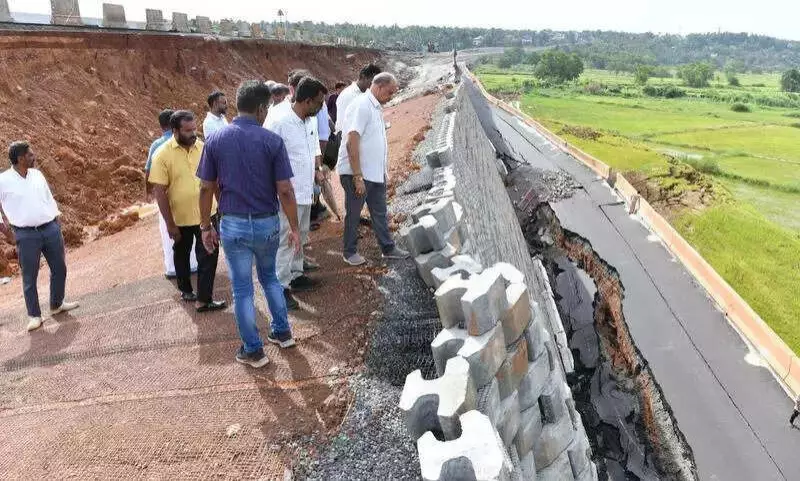
In a decisive response to recent structural concerns, the National Highways Authority of India (NHAI) has launched one of the most extensive geotechnical evaluation exercises ever undertaken on a national highway corridor in the country. The focus is on the crucial NH-66 stretch running through Kerala.
Unprecedented Scale of Investigation
The authority has mobilized a massive technical effort to ensure the long-term safety and integrity of the highway. Eighteen specialized geotechnical agencies have been tasked with conducting detailed soil investigations. Their work will cover a staggering 378 specific locations linked to structures and reinforced soil (RS) walls.
This comprehensive assessment spans across 18 different NH-66 projects in the state. The audit leaves no section unchecked, covering completed stretches, areas currently under construction, and even projects that have not yet begun. This ensures the entire corridor receives a thorough examination.

From Audit to Action: Remedial Measures Guaranteed
According to an official NHAI statement, the findings from these extensive field and laboratory studies will form the basis for a complete re-examination of the design and construction of all reinforced soil walls on the national highway. The authority has adopted a zero-compromise stance on quality and safety.
Where any deficiencies are identified, necessary remedial measures will be implemented. This includes actions like dismantling and reconstruction to ensure full compliance with the strictest prescribed engineering standards. The statement emphasized that corrective steps will be taken without any compromise.
Expanding Independent Safety Oversight
Running parallel to the geotechnical survey, NHAI is significantly widening the scope of independent safety audits. It is engaging expert agencies, including RITES, for this critical task. While these audits were initially commissioned for specific projects like the Aroor-Thuravoor elevated road, they are now being extended to other sections of NH-66.
The core objective is proactive risk mitigation. The expanded audits aim to identify any systemic issues in construction practices, material quality, or safety protocols before they can pose a threat to construction workers or the millions of future highway users.
A Long-Term Vision for Kerala's Infrastructure
NHAI clarified that these robust measures highlight a larger commitment to building resilient infrastructure. The statement articulated a vision where NH-66 is engineered not merely for present traffic but to serve Kerala safely and reliably for decades to come.
"Engineered with scientific rigour, continuously monitored and corrected wherever necessary, the corridor exemplifies a maturing approach to infrastructure development that aligns ambition with safety and accountability," the authority stated.
As NH-66 progresses, it is positioned as more than a connectivity project. NHAI frames it as a long-term investment in a safer, stronger, and more connected Kerala, underscoring the role of modern highway frameworks as instruments of inclusive and sustainable growth.