

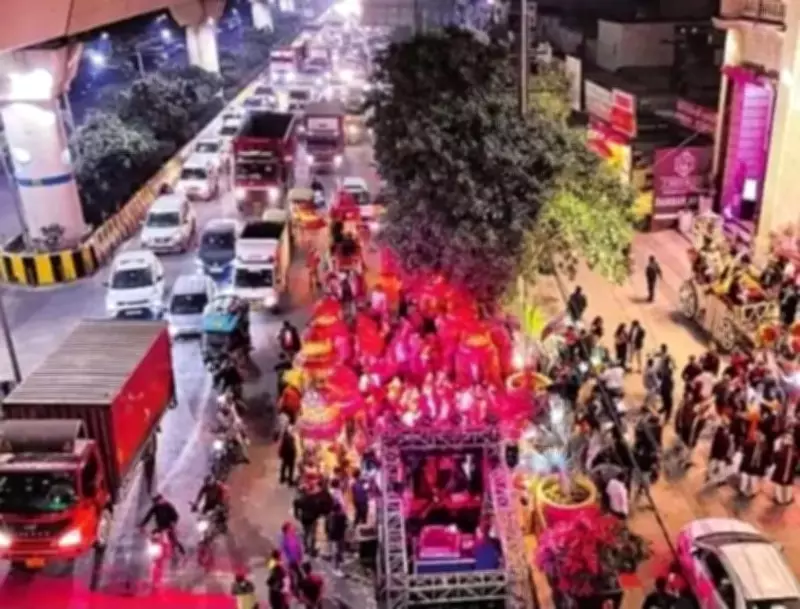
Noida Wedding Season Brings Noise Pollution Woes to Residential Sectors
The resurgence of vibrant wedding celebrations, complete with brass bands, traditional 'baaja', and lively 'baraat' processions, has reintroduced a significant nuisance for many residents in Noida. Over recent days, inhabitants of Sectors 50 and 51 have voiced escalating complaints regarding the excessive noise pollution emanating from the numerous banquet halls in these areas.
Legal Noise Limits and Resident Grievances
According to the Uttar Pradesh Pollution Control Board (UPPCB), permissible noise levels in residential zones are capped at 55 decibels during daytime hours from 6 am to 10 pm, and 45 decibels at night from 10 pm to 6 am. These thresholds are designed to maintain ambient sounds comparable to a standard conversation between individuals standing within three feet, or the gentle hum of household appliances like refrigerators or dishwashers.
However, residents report that heavy bass from DJ sets and loud firecrackers frequently surpass these limits, disrupting their nightly rest. Describing the situation as a "daily assault", they attribute the problem to the proliferation of new banquet halls over the past five years. Sanjay Sabikhi, a resident of Sector 50, lamented, "Every time there’s a weekend or a wedding, the music goes on till late. Kids studying can’t concentrate. We can’t sleep. It goes on well beyond 10pm, and I doubt if any of these banquets here take permission to keep their loudspeakers running."

Escalating Complaints and Legal Actions
In response, the Noida Federation of Apartment Owners Associations filed a formal police complaint on March 27. Despite this, Rajiva Singh, the federation president, noted that conditions have deteriorated further. He recounted, "On Tuesday, between 9pm and 10.30pm, we endured the excruciating noise of DJ music and brass bands. Firecrackers only added to the problem. This is a blatant disregard for environmental regulations established by the Central Pollution Control Board (CPCB) and orders from the Supreme Court regarding noise pollution."
Historically, the Supreme Court ruled in 2005 that noise pollution infringes upon the right to life, mandating states to confiscate loudspeakers and amplifiers that exceed permissible levels. Authorities are empowered to take legal action against violators based on public complaints.
On Wednesday, residents escalated their concerns by writing to local officials, including GB Nagar MP Mahesh Sharma, Noida MLA Pankaj Singh, police commissioner Laxmi Singh, and Noida Authority CEO Krishna Karunesh.
Health Impacts and Community Concerns
The noise pollution has raised serious health alarms among residents. Sanjeev Kumar, RWA general secretary of Sector 51 blocks C to F, emphasized, "People celebrating their big days at these venues should be mindful about not creating a menace for the residents. The loud noises affect heart patients and elderly people very badly."
Echoing this, Dr. Ashish Jain, Director and head of the respiratory medicine department at Max Smart Super Speciality Hospital, Saket, and a Sector 50 resident, warned, "High-decibel DJ music, which is usually played at weddings and banquet halls, can cause palpitations and enhanced anxiety, especially in senior citizens with comorbid conditions. Other times, it can be an irritant to the ear and also lead to sleep disorders."
Infrastructure and Regulatory Challenges
In recent years, banquet halls have increasingly appeared on internal sector roads, leading to chaotic conditions marked by unauthorized parking and traffic jams, further disturbing the peace of these neighborhoods. Sharad Jain, a resident of Sector 51, stressed, "There is an urgent need for collaboration between the Noida Authority and the district police to enforce existing noise regulations and curb violations."
Proposed Solutions and Future Measures
To address these pressing issues, the federation has proposed a series of immediate and long-term measures. Key demands include:

- Installation of sound barriers along service roads adjacent to banquet halls, particularly targeting areas opposite Sector 51 and plots F-26 to F-33 in Sector 50.
- Implementation of a freeze on issuing new licenses for banquet halls within residential zones.
- Conducting a feasibility study to explore relocating existing halls to non-residential areas.
Anil Prakash, a resident of Sector 51, summarized the community's frustration, stating, "We have reached the limit of our tolerance and earnestly urge authorities to restore the tranquility and sanctity of our community."





