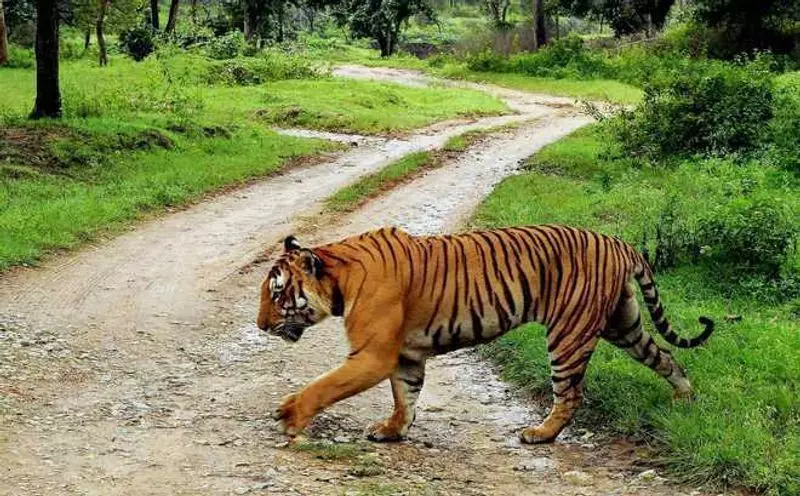
The National Tiger Conservation Authority (NTCA) has raised a red flag over what it describes as "systemic violations" in the ongoing relocation of villages from the core critical tiger habitat of the Kali Tiger Reserve in Karnataka. The findings come from a high-level committee report submitted to the Supreme Court, revealing a process marred by procedural lapses and potential legal oversteps.
Core Committee Uncovers Flawed Process
A committee led by NTCA member-secretary Rajendra G. Garawad, and including Karnataka's chief wildlife warden and the Kali Tiger Reserve's field director, was formed on the Supreme Court's orders. Its mandate was to scrutinize the relocation of villages from the reserve's core area. The committee's investigation, which included field visits and stakeholder interviews, concluded that the entire process suffered from significant deficiencies.
The report highlights that the relocation of four villages—Amagaon, Kumbarawada, Belambara, and Kesarigallu—was approved without following the mandatory procedure of obtaining prior consent from the Gram Sabhas (village councils). This is a direct violation of the Forest Rights Act, 2006, and the Wildlife (Protection) Act, 1972, which require the free, prior, and informed consent of the affected forest-dwelling communities.

Violations of Legal and Financial Protocols
The NTCA report details multiple layers of non-compliance. A major point of contention is the financial package offered to the families. While the state government proposed a compensation of Rs 15 lakh per family, the report notes this was done without a clear, transparent framework for determining the amount. More critically, the process of identifying beneficiary families and disbursing funds was found to be irregular.
Funds were reportedly released and deposited into individual bank accounts without proper verification or the execution of a mandatory tripartite agreement between the family, the forest department, and the district administration. This agreement is crucial as it legally formalizes the relocation, the surrender of forest rights, and the terms of rehabilitation. The absence of such documentation leaves the process legally vulnerable and opaque.
Contradictions and Community Concerns
The committee's findings contradict the Karnataka government's submissions to the Supreme Court, which claimed the relocations were voluntary and based on Gram Sabha consent. The NTCA report, however, points to a lack of documented evidence for such consent. Furthermore, the report recommends that families who wish to return to their original villages should be allowed to do so, and the compensation money deposited in their accounts should be recovered if they choose this option.
This situation has created uncertainty and distress among the displaced communities, who now find themselves in a legal and administrative limbo. The report underscores the tension between urgent conservation goals, such as creating inviolate spaces for tigers, and the imperative to uphold the legal rights of indigenous and forest-dwelling populations.
Broader Implications for Conservation Policy
The Kali Tiger Reserve case is not an isolated incident but points to a larger pattern where relocation processes are fast-tracked, often sidelining legal safeguards. The NTCA committee has also made a significant observation regarding the Nagarahole Tiger Reserve's buffer zone. It noted that human settlements within this buffer are impacting the reserve's ecology and recommended that the state consider a long-term, voluntary relocation plan here as well, albeit with strict adherence to the law.
The report's revelations are expected to influence future relocation projects across India's tiger reserves. It serves as a stark reminder to state governments and forest departments that conservation objectives cannot be achieved by bypassing the rights and due processes established to protect vulnerable communities. The Supreme Court is now poised to examine these findings, which could lead to directives for corrective measures and set a precedent for how human-wildlife conflict and habitat management are legally approached in the country.