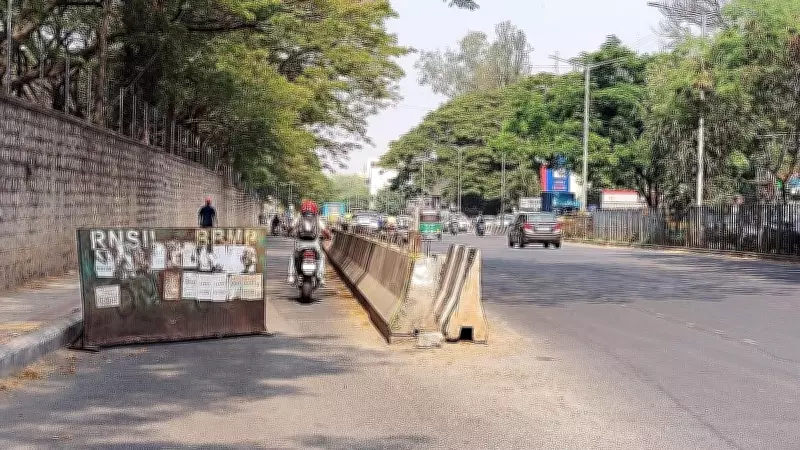
Bengaluru's Old Airport Road is set to receive a third underpass as part of ongoing efforts to decongest one of the city's busiest corridors. The new underpass, proposed near the Kodihalli junction, aims to streamline traffic flow and reduce travel time for thousands of daily commuters. However, concerns remain high over the persistent congestion at the Marathahalli junction, a notorious bottleneck that continues to plague the area.
Details of the New Underpass
The underpass will be constructed at the intersection of Old Airport Road and Kodihalli Road, a critical point that often witnesses heavy traffic snarls. This will be the third underpass on this stretch, following the existing ones at the Domlur and HAL junctions. The project is part of the broader Bangalore Traffic Improvement Plan, which includes multiple infrastructure upgrades across the city.
According to officials from the Bangalore Development Authority (BDA), the underpass will be a two-lane structure spanning approximately 500 meters. The estimated cost of the project is around Rs 50 crore, with a completion timeline of 18 months. The BDA has already begun the tendering process, and construction is expected to commence soon after the monsoon season.

Marathahalli Congestion: An Ongoing Challenge
While the new underpass is expected to ease traffic at Kodihalli, the Marathahalli junction remains a significant worry. This area, which connects Old Airport Road to the Outer Ring Road, experiences severe congestion during peak hours. Commuters often spend over 30 minutes navigating this single junction, leading to frustration and delays.
Traffic experts point out that the Marathahalli bottleneck is caused by a combination of factors, including high vehicle density, lack of proper lane discipline, and inadequate signal management. Despite previous interventions such as the installation of a flyover and signal synchronization, the problem persists.
Local residents and commuters have expressed mixed reactions to the announcement. While many welcome the new underpass, they argue that it does little to address the root cause of congestion at Marathahalli. Some have called for a comprehensive solution, such as a dedicated elevated corridor or a multi-modal transit hub.
Other Measures Underway
The Bangalore Traffic Police have also implemented several measures to manage traffic on Old Airport Road. These include the deployment of additional traffic personnel during peak hours, the use of drone surveillance to monitor congestion, and the introduction of a smart traffic management system. Additionally, the Namma Metro Phase 2 extension, which includes a line along Old Airport Road, is expected to provide long-term relief by offering a viable alternative to road travel.
However, the metro project is still under construction and is not expected to be operational for at least another two to three years. In the interim, commuters will have to rely on road infrastructure improvements like the new underpass.
Public Opinion and Future Outlook
Social media platforms and local forums have been abuzz with discussions about the underpass. Many users have praised the government's proactive approach but have also highlighted the need for more comprehensive planning. A frequent commuter on Old Airport Road, Ravi Shankar, said, "The underpass at Kodihalli is a good step, but the real test will be at Marathahalli. If that junction remains clogged, the overall benefit will be limited."
Urban planners suggest that a holistic approach involving traffic calming measures, improved public transport, and stricter enforcement of traffic rules is necessary to tackle the congestion effectively. They also emphasize the importance of integrating land-use planning with transport infrastructure to prevent the recurrence of such bottlenecks in the future.
As Bengaluru continues to grow, the demand for efficient mobility solutions becomes increasingly critical. The new underpass on Old Airport Road is a positive development, but it is clear that much more needs to be done to ensure smooth and sustainable traffic flow in the city.