

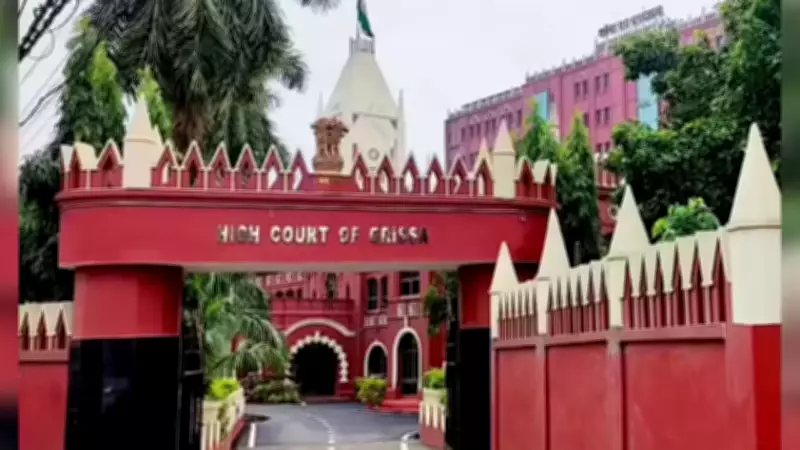
The Orissa High Court has ruled that rising road accidents demand proactive safety measures, and courts should not ordinarily interfere with empirical data based government policy decisions aimed at protecting public safety.
Court Ruling on Barricades
The ruling came from a two-judge bench of Chief Justice Harish Tandon and Justice M S Raman, who dismissed a public interest litigation (PIL) challenging the installation of overhead and mobile barricades in Sector-10 of the Cuttack Development Authority (CDA) area on May 20. The bench held that the measures were aimed at ensuring public safety and preventing accidents in the residential locality. The web copy of the judgment was released online on Friday.
Petitioners' Allegations
Four residents of the CDA area — Khageswar Sethi, Manoj Kumar Pati, Manoranjan Dash, and Susree Sangita Ratha — filed the PIL. One of the petitioners, Manoj Kumar Pati, who is also the president of the Puja Committee of CDA Sector-10, appeared in person and made submissions before the court. Pati alleged that the barricades had drastically reduced the width of the road and created obstruction for buses and emergency vehicles, including ambulances. He claimed the road was of immense importance to residents and sought immediate removal of the barriers to restore free and unhindered movement. Pati further alleged that the barricades were an “unauthorised obstruction” on the road.

Government's Defense
The state and CDA authorities argued that the overhead barriers were installed mainly to prevent heavy-loaded vehicles from entering the locality at high speed, which could endanger the lives and property of residents. Appearing for the state, additional government advocate Sanjeeb Kumar Swain informed the court that there was no restriction on the movement of ambulances during emergencies. Senior advocate Dayananda Mohapatra, representing the CDA authorities, submitted that city buses were continuing to ply on the route and that public transport services in the area had not been affected.
High Court's Observations
Taking on record the submissions, the High Court observed that the overhead mobile barricades shown in the photographs did not appear to be permanent structures. The bench noted that such barricades are often installed to slow down speeding vehicles and minimise the risk of accidents, particularly in densely populated residential areas. The judges pointed out that the locality was primarily residential in nature and inhabited by families, including children who regularly cross roads for schools, playgrounds, and markets. “Safety and security cannot be compromised by any stretch of imagination,” the court observed, while underlining the responsibility of authorities to adopt preventive measures against road mishaps.
Dismissal of PIL
Observing that the barricades were temporary and emergency movement was not completely obstructed, the High Court found no merit in the PIL and dismissed the petition.
The judgment underscores the judiciary's support for data-driven government policies aimed at public safety, particularly in the context of rising road accidents. The court's decision reinforces the principle that temporary safety measures, when based on empirical evidence, should not be lightly interfered with by the courts.






