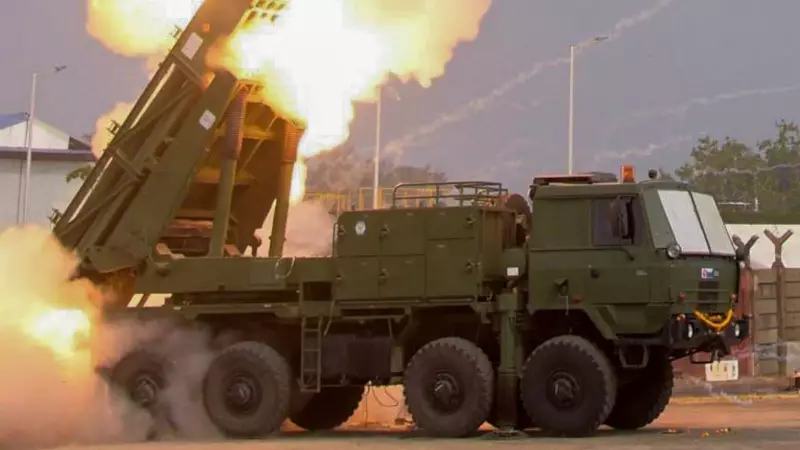
In a significant boost to India's long-range artillery firepower, the Defence Research and Development Organisation (DRDO) on Monday successfully carried out the maiden flight test of the indigenously developed Pinaka Long Range Guided Rocket (LRGR 120). The test, conducted from the Integrated Test Range (ITR) at Chandipur, validated the rocket's enhanced strike capability of 120 kilometers.
A Textbook Launch and Precision Impact
The newly developed rocket, designed by the Pune-based Armament Research and Development Establishment (ARDE), performed flawlessly during its first trial. It achieved its maximum intended range and impacted the target with what officials described as textbook precision. All range instruments deployed at the test site tracked the rocket's entire flight trajectory.
The trial was a coordinated effort involving the ITR and the Proof and Experimental Establishment (PXE). Notably, the LRGR 120 was launched from an in-service Pinaka launcher, demonstrating the system's versatility and the ability to fire different variants of Pinaka rockets from the same launch platform.

Evolution of a Battlefield Game-Changer
The Pinaka system, named after the bow of Lord Shiva, is a cornerstone of India's artillery regiments. The development of this multi-barrel rocket system began in the late 1980s as an indigenous alternative to Russian 'Grad' systems. The Mark-I version, with a range of around 40 km, was first used in combat during the 1999 Kargil War. This was later followed by the Mark-II variant, which can strike targets up to 75 km away.
The new 120-km range variant represents a quantum leap. In battlefield tactics, such long-range artillery is used to soften enemy targets and disrupt their logistics before close-quarter battles begin. A single Pinaka battery, consisting of six launch vehicles, support systems, and a command post, can neutralize an area of one square kilometer.
Boosting Armed Forces' Capabilities
The successful test has been hailed as a major strategic achievement. Defence Minister Rajnath Singh congratulated the DRDO, stating that the development of these long-range guided rockets will significantly boost the capabilities of the Armed Forces and is a "game-changer." DRDO Chairman Dr. Samir V. Kamat witnessed the trial and commended the teams involved.
The project saw collaboration between multiple DRDO facilities. ARDE worked in association with the High Energy Materials Research Laboratory (HEMRL), also based in Pune, with support from Hyderabad-based units—the Defence Research and Development Laboratory (DRDL) and the Research Centre Imarat (RCI).
The integration of the 120-km rocket will dramatically enhance the firepower of existing Pinaka regiments. The system's design emphasizes high mobility, adhering to the critical 'shoot and scoot' doctrine where launchers fire and immediately relocate to avoid counter-battery fire, a vital feature given the system's pronounced back blast.