

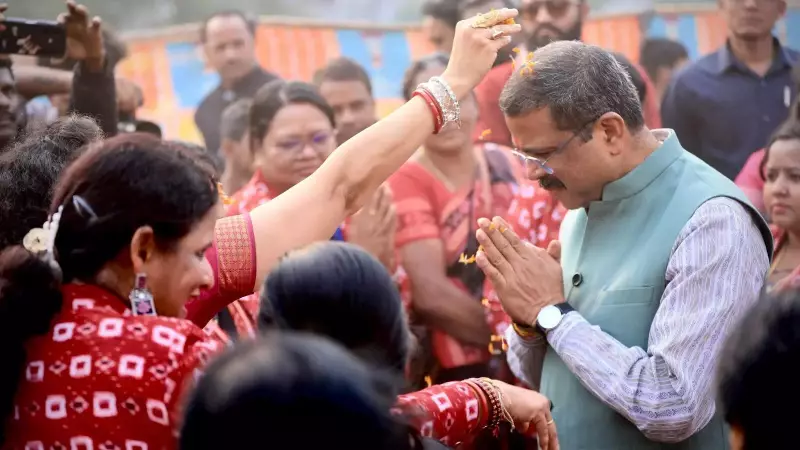
Union Education Minister Dharmendra Pradhan has made a significant move to address a long-standing disparity in reservation benefits. On Tuesday, he formally urged the Union Minister for Social Justice and Empowerment, Virendra Kumar, to synchronize the Centre's Other Backward Classes (OBC) list for Odisha with the state's own State List of Socially and Educationally Backward Classes (SEBC). This push comes ahead of the crucial 2027 Census, which is set to include detailed caste data enumeration.
The Core Issue: 108 Missing Communities
In his communication, Pradhan highlighted a critical gap: 108 castes and sub-castes that find a place in Odisha's SEBC list are conspicuously absent from the central OBC list. This mismatch creates a complex web of administrative and interpretational challenges for the members of these communities. Currently, the central OBC list for Odisha covers approximately 200 communities, while the state's SEBC list is more extensive, comprising 216 communities, each with multiple sub-groups.
The minister pointed out that this discrepancy leads to "administrative ambiguities and interpretational challenges", particularly when individuals migrate to other states or apply for central government jobs, educational admissions, and national welfare schemes. He emphasized that Odisha has a substantial SEBC population, and their exclusion from the central list deprives them of uniform access to constitutionally mandated reservation benefits at the national level.

Implications for Social Justice and the 2027 Census
Pradhan, who is an OBC leader from the Chasa community, argued that aligning the two lists is essential "to advance social justice, inclusive development and ensure consistency between the state and central frameworks." This is not his first effort on the matter; last month, he had written to Hansraj Gangaram Ahir, the chairperson of the National Commission for Backward Classes (NCBC), seeking the inclusion of various Odisha SEBC groups in the central list.
The timing of this appeal is crucial. Government officials have noted that the lack of parity between the state and central lists could significantly complicate the enumeration of backward classes in the 2027 Census. For the first time in decades, the Census will collect detailed caste data beyond just Scheduled Castes and Scheduled Tribes. Any inconsistency between the lists may lead to confusing or inconsistent classification of these communities, undermining the accuracy and purpose of the exercise.
Practical Hurdles and a Defunct Commission
A senior government officer explained a practical hardship: the current misalignment forces community members to obtain separate SEBC and OBC certificates to access different tiers of government benefits. Harmonizing the lists would streamline this process and provide clarity. In a related development, Pradhan also wrote to Odisha's new Chief Minister, Mohan Charan Majhi, on Monday. He urged the immediate reconstitution of the Odisha State Commission for Backward Classes (OSCBC), which has been non-functional since the tenure of its members ended in January last year.
The reactivation of this state commission is seen as a vital step in addressing local concerns and making recommendations for the welfare of backward classes, which could feed into the larger goal of list alignment. As the nation prepares for a socio-economically significant Census, the call for a unified list aims to eliminate bureaucratic hurdles and deliver on the promise of equitable social justice for all backward communities in Odisha.






