

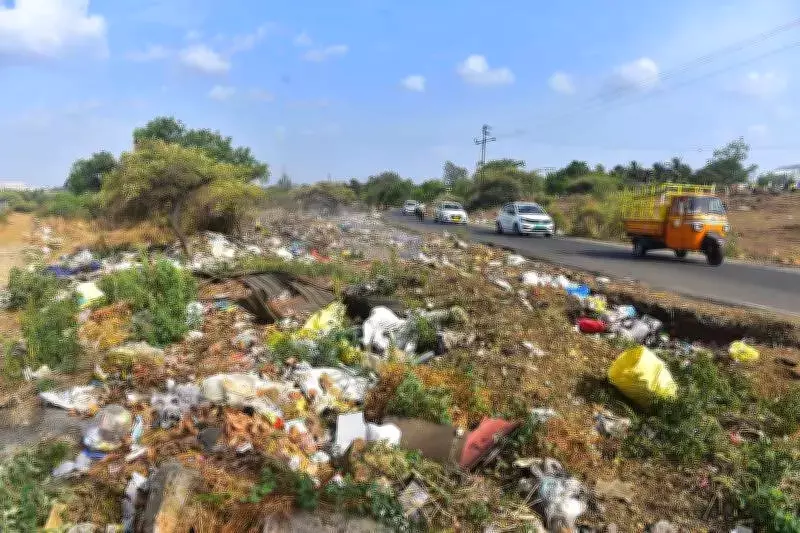
Pune: The city's Air Force Station remains one of India's crucial military aviation hubs, supporting operational flying, logistics, training, and aircraft movements. The adjoining civilian airport at Lohegaon handles numerous commercial flights daily, making the airspace one of the busiest in the region. However, over a year after persistent concerns about bird strike dangers in this vital perimeter, little has changed on the ground. The civic administration has failed to maintain cleanliness and enforce scientific waste management around this strategically important area. Large areas around the air base still suffer from open garbage dumping, unsegregated waste, food refuse, construction debris, and poorly maintained vacant plots.
Ideal Conditions for Birds
These conditions have created an ideal habitat for birds, especially crows, kites, pigeons, egrets, and other scavenging species, heightening the risk of bird-aircraft collisions during take-off and landing. Residents, aviation experts, and former defence officials say that despite repeated complaints, inspections, and advisories over the years, the Pune Municipal Corporation (PMC) has failed to address the issue sustainably. Air Commodore Satbir Singh Rai, Air Officer Commanding, Pune Air Force Station, stated, "Bird strikes remain one of the most serious wildlife hazards in aviation. A collision between a bird and an aircraft engine, windshield, or critical flight surface can lead to severe damage and, in rare cases, catastrophic consequences. We need to prioritize cleanliness to avert any tragedy."
Mounds of Trash Everywhere
According to aviation safety norms, areas around airports and air bases must be kept free from conditions that attract birds. Open garbage, slaughter waste, food leftovers, stagnant water, and unmanaged vegetation are among the biggest contributors to bird congregation. However, visits by TOI around the station revealed a different picture. Garbage heaps are seen along roadsides, near residential pockets, and on vacant plots. In some places, mixed waste remains unattended for days. Construction and demolition debris is dumped illegally, and birds circle overhead in large numbers.

In May, Indian Air Force (IAF) station authorities said they were considering filing police complaints against people found dumping garbage near the airbase. Residents said they have raised the issue with PMC multiple times but in vain. "Garbage is cleared occasionally, but within a few days, fresh waste starts accumulating. There is no regular monitoring," said Lohegaon resident Vishal Patil. Another resident, Asha Shinde, said, "The stench is unbearable during summer and monsoon. Dumps also attract rodents and insects. It is a public health issue, too."
Environmental Concerns
Environmentalists said the problem reflects deeper shortcomings in urban waste management. "Pune generates thousands of tonnes of waste daily. Segregation at source is inconsistent and enforcement against illegal dumping weak. Around sensitive zones such as airports and military installations, the standards should be much stricter," said urban planner and environmental researcher Prakash Kulkarni.
Hazard in the Skies
The concern over bird strikes is not theoretical. Bird hits have been reported at airports across India for decades, causing aircraft damage, flight delays, and operational disruptions. Aviation experts note that even a single strike costs lakhs of rupees in repairs and grounding of aircraft. Between 2022 and August 2025, 120 incidents of bird strikes were documented around Pune airport, highlighting the risks.
Military aircraft are not immune to the threat. Fighter jets, transport aircraft, and helicopters often operate at varying speeds and altitudes during training and operational missions. A bird strike can result in engine failure or significant damage. Former aviation safety officials say that bird hazards around airports are usually linked to human activity rather than natural causes. "Birds gather where food is available. If garbage is managed scientifically, bird numbers around airfields reduce," said an aviation safety consultant who has worked on wildlife hazard management for airports.

Residents close to the Air Force Station said they frequently observe large flocks of birds around waste dumping sites, particularly during early morning and evening hours. "There are days when dozens of kites can be seen hovering over garbage piles. The sight is common, but it should not be normal near an airport," said resident Imran Shaikh.
Ornithology Insights
Ornithology professor Dr. Satish Pande, who has studied bird patterns at various airports like Pune and Mumbai, said, "There is a dedicated branch called ‘airport ornithology'. Experts should be roped in to study bird patterns in and around the airport. Such specialists work at international airports across the world." On his observations at Pune airport, Pande said, "Multiple factors are involved behind flocking of birds in and around this facility. Apart from garbage dumping, other factors need to be studied, such as high nesting sites in the vicinity, water bodies, flying time, grass patches on runways, high-rise buildings where pigeons flock, etc. If you understand these issues scientifically, you will be able to change flight schedules or frequency in a particular time zone to prevent an air crash or mishap."
PMC's Failure and Negligence
The IAF and airport authorities routinely undertake bird hazard assessments and wildlife control measures within their premises, but their ability to manage risks beyond the perimeter remains limited. Defence observers noted that airfield safety is a shared responsibility requiring coordination among municipal authorities, airport operators, defence establishments, and residents. "Bird-attracting activities outside the station boundary require civic intervention. Unless local bodies act, the risk cannot be eliminated," a senior IAF officer told TOI.
Pune Air Force Station and the adjoining airport are surrounded by rapidly urbanising neighbourhoods. In the past decade, residential and commercial development has skyrocketed in Lohegaon, Dhanori, and adjoining areas. While urban growth has increased waste generation, infrastructure and enforcement have not kept pace. Residents allege that illegal dumping continues on open plots. In some locations, waste contractors and private vehicles allegedly dump debris and mixed garbage under the cover of darkness. Citizen groups have sought stricter surveillance, CCTV installation, and regular clean-up drives in areas around the air base — but in vain. "We are not asking for extraordinary measures. Basic waste collection, segregation, and enforcement can solve much of the problem. Unfortunately, the response has been reactive rather than preventive," said local activist Nitin Jadhav.
While PMC had launched a ‘Vishwa 2025' waste management pilot in Vimannagar in September 2025, it soon garnered criticism over inconsistent street cleaning, ill execution of waste collection, and more.
Solutions Unimplemented
Experts have suggested many ways to address the problem: strict enforcement, daily waste collection, scientific processing of food waste, removal of unauthorised dumps, better vacant plot maintenance, sustained public awareness campaigns, and a dedicated coordination mechanism involving PMC, airport authorities, IAF, and local stakeholders. Civic chief Naval Kishore Ram said the issue is a priority as it has serious ramifications. "We plan to launch a special drive to clean Lohegaon and surrounding localities. We will ensure sustained efforts to improve the situation," said Ram, adding, "We were unable to process garbage collected here in March-April as our plants were dysfunctional. They have been repaired. This issue will be addressed systematically."
The commissioner had visited the areas in July last year and warned of action against private plot owners who failed to stop people from dumping garbage in their properties. But no action was taken thereafter. Ram reiterated to TOI in June, "I will visit the areas again to ensure improvements. We understand how it is crucial for aviation safety." But for residents, it comes down to accountability. "The authorities know where the dumping spots are. Citizens have reported them repeatedly. If these locations can be identified, they can be cleaned and monitored," said resident Sneha More.
Aviation safety experts warned that every unmanaged garbage pile around an airfield becomes a bird feeder, increasing chances of birds entering flight paths. "As Pune continues to grow and air traffic increases, the need for effective waste management around the Air Force Station becomes more urgent. What appears to be a routine municipal lapse on the ground can translate into a significant aviation hazard in the sky," said Group Captain Johnson Chacko (Retd), former fighter pilot. "The city that hosts one of the country's key military air bases and a busy civilian airport, ensuring clean surroundings is no longer merely a civic responsibility. It is a matter of public safety, national security, and operational readiness," he added.
Stay updated with the latest Pune news. Download the TOI App.





