

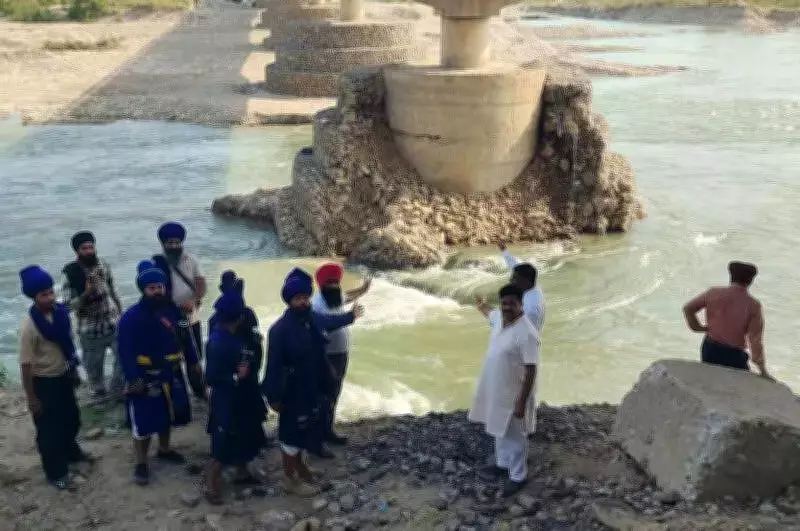
Ahead of the monsoon season, visible damage to the protective structures around the piers of the Agampur-Anandpur Sahib bridge over the Satluj River in Ropar district has raised concerns among residents and commuters. Questions are being raised about the quality of construction and the overall safety of the bridge.
Bridge Details and Stress Factors
The bridge, which is 1 kilometer long and 7.5 meters wide, was constructed in 1986 at an estimated cost of Rs 70 crore. It has reportedly been under increasing stress due to extensive mining activities in the riverbed. The bridge serves as a critical link between Anandpur Sahib and Punjab's Doaba region, used by thousands of pilgrims and commuters throughout the year.
Previous Damage and Repairs
Over two years ago, officials reported that several piers were left exposed because scouring had severely affected their foundations. The Public Works Department (PWD) later sought funds for repair and protective measures.

Fresh Concerns
New concerns have emerged after damage was noticed in gabion crates and other scour-protection works around one of the bridge piers, despite the Satluj River flowing at relatively low levels. Fears have intensified following the Bhakra Beas Management Board's decision to increase water releases from Bhakra Dam during the ongoing paddy transplantation season.
Alleged Use of Substandard Material
A key point of dispute is the alleged use of "black stone" instead of the commonly used Pathankot stone for protecting the bridge foundations. Residents said that bridge-protection works have traditionally used large Pathankot boulders packed in wire-mesh gabion crates due to their weight and ability to withstand strong currents. However, residents and social activist Gaurav Rana alleged that smaller crushed quarry aggregate was used in the recent work instead, claiming it lacks the required mass and durability to resist erosion and fast river flows.
Prolonged Mining and Environmental Impact
Broader structural worries have also been connected to environmental harm linked to prolonged mining. The issue of illegal mining is pending before the Punjab and Haryana High Court. While hearing a civil writ petition, the court recently ordered an interim ban on mining and desilting near Agampur and instructed the Ropar Deputy Commissioner to inspect the site personally and submit a detailed affidavit. The court also asked for information on the PWD project, including tender documents and details of the contractor engaged for the restoration.
Locals said that natural formations that worked as a buffer and helped control currents near the bridge were washed away during last year's flood due to illegal mining in Harsabela. People from Harsa Bela village recently opposed excavation close to the bridge. Officials described the work as scientific desilting intended to shift hydraulic pressure away from vulnerable piers, while residents claimed natural protective features were removed and the extracted material was sold to stone crushers.
Gaurav Rana has called for an independent probe into procurement and implementation, arguing that damage appearing before the monsoon indicates major lapses.
Official Response
SS Bhullar, Executive Engineer of the Buildings and Roads Division, Ropar, said the damage was not widespread. "Only one bridge pier suffered damage to its protective crates. Packing work at that location was still incomplete when the crates were damaged due to increased pressure following flash water. Payment to the contractor was also pending as the work had not been completed. The restoration work is underway and around 15 days remain before the repair deadline," he said. He added that the material used for the restoration work was as per norms, but if there are any complaints, they would get it checked again.






