

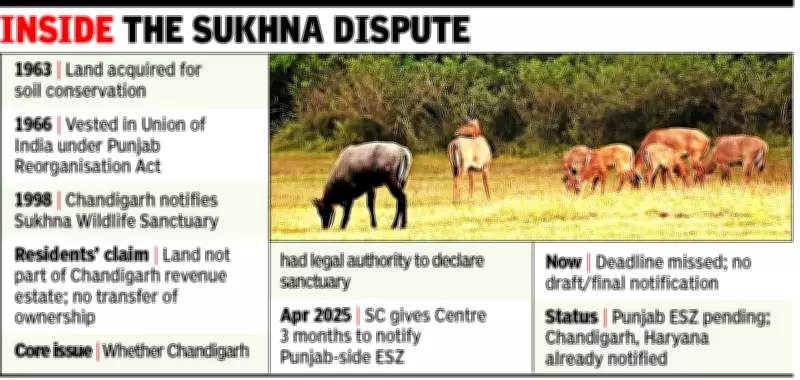
Mohali: More than a year after the Supreme Court directed the Union environment ministry to notify the eco-sensitive zone (ESZ) on the Punjab side of the Sukhna Wildlife Sanctuary, the process remains incomplete, raising questions over compliance and reviving a long-running legal dispute over the sanctuary’s validity.
Supreme Court Order and Delay
In its April 16, 2025 order, the apex court had given the ministry three months to complete the notification. Despite the lapse of the deadline, neither a draft nor a final ESZ notification has been issued. The pending proposal covers the Punjab-side boundary of the sanctuary.
Proposed ESZ Buffer Details
Of the roughly 13.2km stretch adjoining Punjab, around 85% has been proposed to have an ESZ buffer of 1–3km. Nearly 2km, abutting municipal limits and dense habitations, has been proposed with a reduced 100m buffer.

Residents’ Objections
The delay has also reignited objections from Kansal residents over the 1998 notification declaring the Sukhna Wildlife Sanctuary. They contend Chandigarh lacked the legal authority to notify the sanctuary as the land does not form part of its revenue estate.
According to residents, the land was acquired in 1963 under the Land Acquisition Act for soil conservation and, after Punjab’s reorganisation in 1966, vested in the Union of India under Schedule XIII of the Punjab Reorganisation Act for that limited purpose. They argue the land was neither transferred to Chandigarh nor its land use altered through any statutory process.
They also cite Schedule II of the Act, which lists properties transferred to Chandigarh, contending that land earmarked for soil conservation was treated separately and that vesting for a specific purpose cannot be construed as transfer of ownership.
“The core issue is not just the ESZ but whether Chandigarh had the authority to declare a wildlife sanctuary on land vested in the Union of India,” residents opposing the notification said.
Regional Context and Uncertainty
The issue has gained significance as Chandigarh and Haryana have already notified their ESZs around the sanctuary, while Punjab’s proposal remains pending with the ministry despite clear court directions. With questions of land ownership, statutory authority and environmental regulation converging, the delay has created uncertainty for residents and planners alike—leaving two key questions unresolved: why the ESZ notification is still pending, and whether the 1998 sanctuary notification itself is legally sustainable.

ESZ Proposal on Punjab Side
- Covers 13.2km stretch along sanctuary boundary in Punjab
- 85% area: 1–3km eco-sensitive buffer proposed
- 2km near dense habitations: 100m buffer proposed
- Notification still pending with MoEFCC despite SC directive





