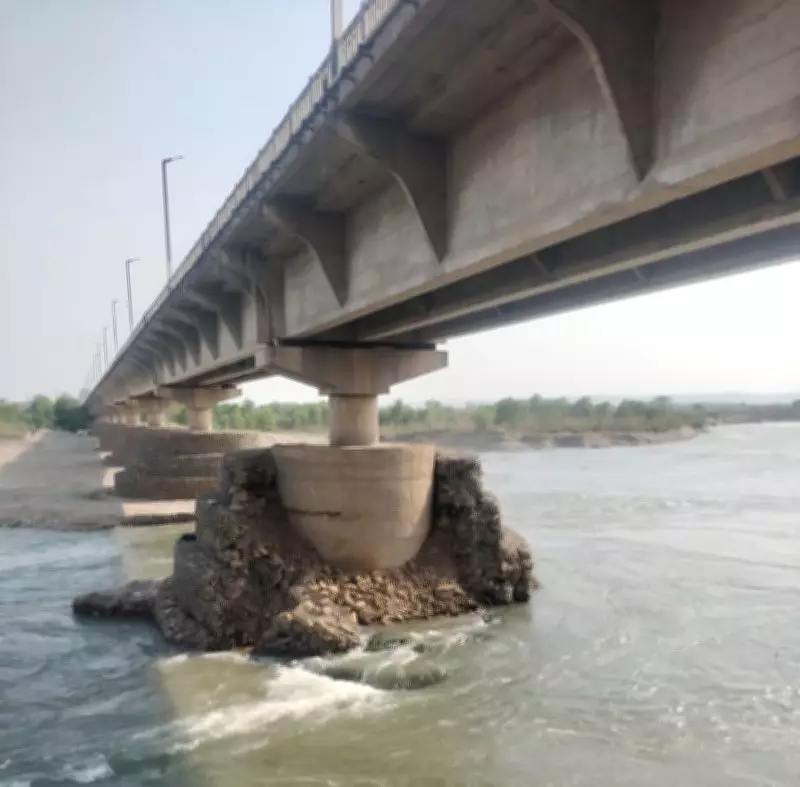
A fresh controversy has erupted in Punjab’s Ropar district after flood protection structures built around the pillars of the Agampur bridge near Anandpur Sahib were damaged due to a sudden increase in the Sutlej River’s water flow. The incident has reignited concerns over large-scale desilting operations being carried out in the riverbed under the state’s flood control programme.
Damage to Protection Works
The damage occurred late Monday night when nearly 40,000 cusecs of water flowed through the Sutlej, driven by rainfall in the upper catchment areas and additional releases from the Bhakra reservoir. The Agampur bridge is a vital link connecting the Doaba region with Anandpur Sahib, making its structural safety a matter of significant public concern, especially with the monsoon season approaching.
Residents Blame Excavation
Local residents, who have been opposing desilting activities near the bridge for several months, alleged that extensive excavation of sand and gravel from the riverbed had altered the river’s natural course. According to them, the removal of naturally formed sand and gravel ridges disturbed the flow pattern, directing stronger currents towards the bridge pillars and undermining the newly constructed protection structures. Villagers claimed that thousands of truckloads of sand and gravel had been extracted from the Sutlej in the name of desilting, arguing that the large-scale removal amounted to commercial mining rather than genuine flood mitigation.

PWD’s Response
The Public Works Department (PWD), however, maintained that the protection work was still underway and had not yet been completed. Executive Engineer of PWD Ropar, HS Bhullar, stated that the department had not released any payment to the contractor responsible for the work. “The protection work around the pillars of the Agampur bridge is still in progress. Since no payment has been made, the contractor will repair the damage at his own cost,” Bhullar said.
Judicial Scrutiny of Desilting Policy
The incident comes at a time when Punjab’s river desilting policy is facing intense judicial scrutiny. The Punjab and Haryana High Court, as well as the National Green Tribunal (NGT), have expressed concerns over allegations that illegal sand mining is being carried out under the guise of desilting and flood-control measures.
High Court Stay Order
In a recent development, the Punjab and Haryana High Court ordered a stay on activities depicted in photographs annexed with a petition alleging illegal mining in the Sutlej and Swan river areas of Ropar district. The interim order was passed on June 8 by a Division Bench comprising Justice Sandeep Moudgil and Justice Neerja K Kalson while hearing a civil writ petition filed by Prem Dutt Sharma, a resident of Ropar.
NGT Restraints
The Principal Bench of the National Green Tribunal has restrained the Punjab Government from permitting further dredging or desilting operations for commercial purposes under 79 disputed tenders without mandatory environmental safeguards. The NGT observed that the State’s ‘No Cost to Government/Volume Share’ model could effectively facilitate commercial sand mining under the cover of desilting. It directed that no such operations should continue without District Survey Reports, replenishment studies, and environmental clearances mandated under the Environmental Impact Assessment Notification, 2006. However, the Tribunal clarified that genuine desilting required for disaster management, maintenance, and flood-control purposes could continue through appropriate mechanisms, provided they did not involve commercial exploitation of riverbed resources.
Apprehensions Ahead of Monsoon
With the monsoon season imminent, residents living along the banks of the Sutlej remain apprehensive about the river’s changing course and its potential impact on villages and critical infrastructure.