

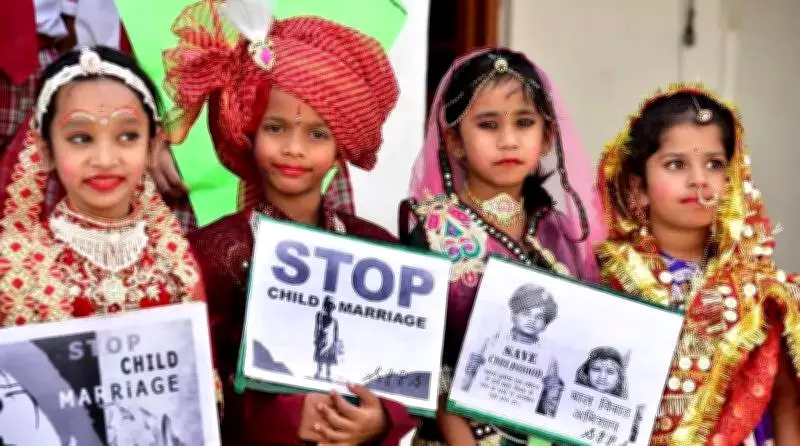
Telangana Child Marriage Study Shatters Stereotypes, Reveals Unexpected Patterns
A groundbreaking survey in Telangana has uncovered that child marriage is not confined to the communities traditionally associated with the practice. The findings from the Independent Expert Working Group report and Telangana Socio-Economic, Educational, Employment, Political and Caste survey present a complex picture that defies simple categorization.
Widespread Prevalence Across Social Groups
The comprehensive study reveals that approximately 2.16 lakh girls, representing around 5% of the surveyed population, were married before reaching the legal age of 18 years. At the broader social-group level, the highest share was found among Backward Classes at 4.6%, followed by Other Classes at 4.4%, Scheduled Castes at 4%, and Scheduled Tribes at 3.8%.
However, when the data is examined more closely across specific castes, a strikingly different pattern emerges that challenges conventional assumptions about which communities are most affected by this practice.

Surprising Spikes Among Privileged Castes
The report identifies some of the most unexpected findings within relatively privileged caste groups. The highest share of married girls below 18 was recorded among Iyengar/Iyer communities at an astonishing 21.2%, which is more than five times the state average. This is followed by Jain communities at 11%, approximately twice the state average.
Volume II of the survey presents another range for 56 major castes, placing the state average for girl child marriage at 4.8%. The highest incidence among major castes was found among Gangiredlavaru at 8.1%, while the lowest was recorded among Kapu communities at 2.1%.
The survey clearly indicates that child marriage exists across all communities, ranging from 2% among Kapu to 8% in BC-A Gangiredlavaru. The report further notes that the practice is particularly prevalent among OC Muslims and BC-E Shaik Muslims.
Two Simultaneous Realities
The data points to two coexisting realities: while Backward Classes show slightly higher rates at the broader social-group level, within the caste-wise breakdown, some Other Class groups demonstrate unusually high shares of child marriage. This complexity makes the findings difficult to fit into simplistic stereotypes.
The persistence of child marriage across communities despite urbanization, educational expansion, and economic mobility suggests a social problem that survives even where material advancement might be assumed to have reduced it.
Cultural Residues in Urban Settings
The survey material argues that cultural residues of backwardness can persist even in highly urbanized and supposedly advanced castes. It notes that professional or official detachment from caste identity does not necessarily insulate communities from traditional practices that restrict girls' autonomy and education.
Even in urban environments where exposure and anonymity are greater, child marriage and discrimination against girls appear to persist, indicating deep-rooted social patterns that transcend geographical and economic boundaries.
Field Perspectives from Experts
Dr. Mamatha Raghuveer Achanta of Tharuni Foundation, which has worked extensively on preventing child marriages in Telangana, provides important context from field studies. "In our field studies, we found child marriage is highest in the Lambada community among Scheduled Tribes," she explains. "We also found it high in certain Backward Class communities, such as Perika and Budaga Jangalu. The recent trend shows an increase among Scheduled Castes."
Dr. Achanta notes that districts like Adilabad, Warangal, and Nizamabad have historically reported high numbers of child marriages, though the practice is not confined to any single region or community.
The Deeper Warning: Educational Deprivation
The survey places the issue of child marriage within the wider context of women's educational deprivation in Telangana. A staggering 65.5% of women in the state have not studied beyond Class 10, revealing a profound educational gap that affects life opportunities and social mobility.

Among social groups, this educational deprivation is most severe among Scheduled Tribes at 72.3%, followed by Backward Classes at 67.1%, Scheduled Castes at 66.5%, and Other Classes at 55%.
Caste-Wise Educational Disparities
When examining major castes specifically, the highest share of women who did not study beyond Class 10 was reported among ST Kolam women at 82.9%, reflecting extremely poor educational access and outcomes among tribal girls. Other groups with very high shares include SC Beda, BC-D Mali, BC-A Odde, and ST Gond communities.
At the opposite end of the spectrum, OC Brahmins reported the lowest share at 36.2%, followed by OC Rajus, OC Jains, OC Komatis, OC Kammas, and OC Iyengars/Iyers, all well below the state average. This educational disparity highlights how social privilege translates into educational advantage, even as child marriage persists across caste lines.
Broader Implications and Social Challenges
The survey findings collectively point to a complex social landscape where traditional practices persist alongside modernization. The data suggests that addressing child marriage requires moving beyond simplistic community-based assumptions and developing more nuanced interventions that recognize the practice's persistence across social strata.
The connection between educational deprivation and child marriage emerges as a critical area for policy intervention, with the survey indicating that improving educational outcomes for girls could be a key strategy in reducing early marriages across all communities.
As Telangana continues its development journey, these findings serve as a crucial reminder that social transformation requires addressing deep-seated cultural practices that affect women's autonomy and opportunities, regardless of community or caste background.





