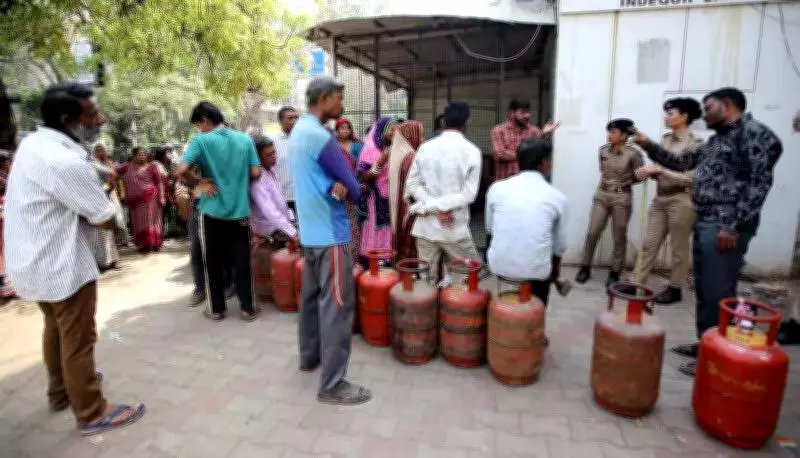
956 LPG Cylinders Vanish from Gujarat Gas Agency Amid Statewide Shortage Crisis
In a shocking development that has compounded the ongoing LPG shortage crisis in Gujarat, a major irregularity has been uncovered in Jhagadia town of Bharuch district. A staggering 956 domestic gas cylinders have mysteriously disappeared from a Bharat Petroleum dealership, causing significant financial losses and raising serious questions about distribution integrity.
Massive Discrepancy Discovered During Stock Verification
The alarming shortage was detected during a routine stock verification conducted at the godown of Nisarg Gas Agency on Monday. The audit revealed that 956 domestic LPG cylinders, each weighing 14.2 kilograms, were completely unaccounted for. The agency's warehouse, located in a secluded area on ITI Road, showed this massive discrepancy during the verification process.
According to police reports, the agency's office is situated near HDFC Bank in Jhagadia, while the storage facility where the discrepancy was discovered is in a more isolated location. This geographical separation may have contributed to the delayed detection of the missing cylinders.

Financial Impact and Police Complaint
The owner of Nisarg Gas Agency, Digvijaysinh Valvi, who resides in Surat, has filed a formal complaint with Jhagadia police regarding the massive loss. Valvi operates the agency that deals in both domestic and commercial LPG cylinders, serving the local community's essential fuel needs.
The financial impact of this irregularity is substantial. Valvi reported a total loss exceeding Rs 17.57 lakh, which breaks down into two major components:
- Rs 3.71 lakh towards refilling costs for the missing cylinders
- Rs 13.86 lakh representing the value of the cylinders themselves
This significant financial blow comes at a particularly difficult time when many households across Gujarat are already struggling with LPG shortages and long queues for cylinder refills.
Questioning and Investigation Underway
Police have questioned the agency's warehouse keeper, Piyush Gamit, who has been employed at the facility for the past 13 years. When confronted about the massive shortfall, Gamit allegedly provided an explanation that failed to satisfy the agency owner or investigating authorities.
According to initial reports, Gamit claimed that some cylinders had not been returned by customers while others had been sold by him. However, the scale of the discrepancy – nearly one thousand cylinders – raised immediate red flags about the validity of this explanation.
Unsatisfied with the warehouse keeper's account, Valvi approached Jhagadia police to file a formal First Information Report (FIR). The complaint details the financial losses and requests a thorough investigation into the matter.
Police Investigation and Broader Implications
Police Inspector G I Rathod confirmed that an active investigation is underway to determine the full scope of this irregularity. Authorities are working to identify any additional individuals who may have been involved in the disappearance of the cylinders.
A key focus of the investigation is determining whether the missing cylinders were illegally diverted and sold on the black market. Given the current LPG shortage affecting many parts of Gujarat, there is concern that such illegal diversions could be exploiting the supply crisis for illicit profit.
This incident raises serious questions about inventory management and security protocols at LPG distribution centers, particularly during periods of high demand and supply constraints. The case has drawn attention to potential vulnerabilities in the distribution system that could be exploited during shortage situations.
The timing of this discovery is particularly significant as it comes amid widespread reports of LPG shortages across Gujarat, with many households facing extended waiting periods for cylinder refills. The disappearance of nearly one thousand cylinders from a single dealership represents a substantial portion of local supply that could have alleviated some of the pressure on consumers.

As the investigation continues, authorities are examining records, interviewing personnel, and tracing potential leads to determine exactly how such a massive quantity of essential household fuel could vanish without detection until a formal audit was conducted.