

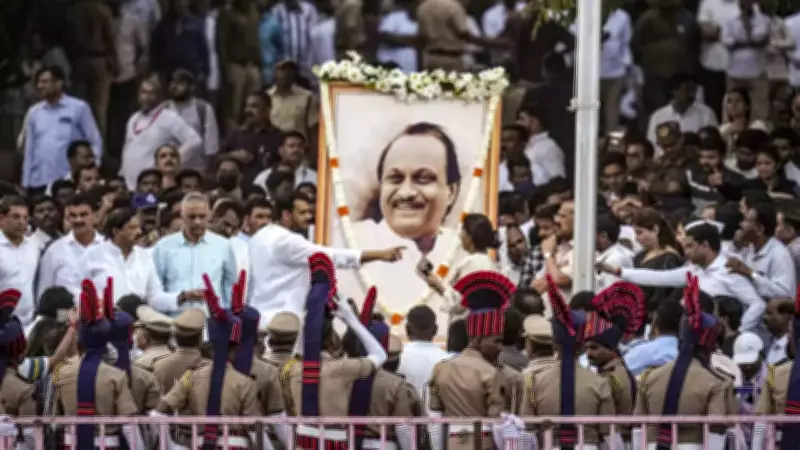
Ajit Pawar: The Political Survivor Who Shaped Maharashtra Politics for Decades
In the complex tapestry of Maharashtra politics, few figures commanded the unique blend of deep respect and subtle fear that Ajit Pawar evoked. He was not a politician who inspired instant adoration, but those who came to respect him did so with unwavering conviction. His career, though frequently shadowed by controversy, demonstrated remarkable political acumen that allowed him to navigate every challenge and reclaim his position at the decision-making table, regardless of electoral outcomes.
Early Life and Political Grooming
Born in 1959 into the politically dominant Pawar family, Ajit Pawar grew up under the towering shadow of his uncle, Maratha strongman Sharad Pawar. While Sharad Pawar mastered the art of mass connection, Ajit focused on understanding the machinery behind the crowds. He developed exceptional skills in comprehending numbers, building networks, and mastering the mechanics of governance. This ground-level networking, particularly in the family stronghold of Baramati, earned him the extraordinary distinction of remaining undefeated in every election he contested throughout his career.
The Baramati Fortress and Electoral Dominance
Baramati transformed from a mere constituency into an impregnable political fortress under Ajit Pawar's stewardship. His electoral journey began spectacularly in 1991 when he won the Baramati Lok Sabha seat by a record margin exceeding 3.36 lakh votes, among the largest victory margins in India at that time. In a move that revealed both loyalty and political calculation, he subsequently resigned from Parliament to facilitate Sharad Pawar's return to the Lok Sabha. That same year, he captured the Baramati assembly seat, which he would retain for eight consecutive terms until 2024, often with victory margins surpassing one lakh votes.

As his responsibilities expanded at the state level, his wife and sons meticulously nurtured the constituency and managed his campaigns. Ajit Pawar's involvement typically culminated with a concluding election rally in Baramati, after which victory was virtually assured.
Controversies and Political Resilience
Ajit Pawar's political journey was repeatedly interrupted by serious allegations including irrigation scams, cooperative bank issues, questionable land deals, and the infamous 'urinate in the dam' remark that significantly damaged his public image. Each controversy left its mark, but none succeeded in destroying his political career.
The 2012 irrigation scandal, involving alleged irregularities in projects worth approximately Rs 70,000 crore, forced his resignation from the cabinet. However, he was reinstated weeks later after official explanations attributed procedural lapses primarily to bureaucratic failures. The most damaging moment came during a 2013 drought protest when his off-the-cuff remark suggesting urinating into a dam would not fill it sparked widespread outrage. He later apologized and called it his biggest mistake, but the political damage proved lasting.
Alliance Shifts and Deputy Chief Minister Tenures
Ajit Pawar served as Deputy Chief Minister six times, controlling crucial departments while never quite crossing the final threshold to the Chief Minister's chair that remained his unfulfilled ambition. The political rift with his uncle widened significantly after his son Parth lost the 2019 Lok Sabha election, culminating in Ajit Pawar joining the 72-hour Devendra Fadnavis government in 2019 and eventually breaking away from his uncle in 2023.
In November 2019, in dramatic early morning developments, he allied with the BJP and was sworn in as Deputy Chief Minister in Fadnavis's government that collapsed within 80 hours. This episode revealed his willingness to take significant political gambles. He returned as Deputy Chief Minister a month later in the Maha Vikas Aghadi government, serving as finance minister between 2019 and 2022. In July 2023, he led a vertical split in the NCP, joined the BJP-Shiv Sena government, and became Deputy Chief Minister again, taking charge of finance and energy portfolios while maintaining his commitment to Shahu-Phule-Ambedkar ideology.

Beyond Politics: Sports Administration and Personal Style
Ajit Pawar's influence extended significantly into sports administration. As president of the Maharashtra Olympic Association for multiple terms, he functioned more as a hands-on coordinator than a figurehead, bringing together state federations across disciplines and pushing for structured development. His leadership of the Maharashtra State Kabaddi Association reflected his deep understanding of rural Maharashtra, where sport and livelihood often intersect. He supported professional pathways without weakening grassroots systems, and his involvement with kho kho and cycling associations ensured attention reached beyond mainstream sports.
Known for his exceptional memory for names and genuine interest in party workers' families, Ajit Pawar shared an ease with grassroots workers that few politicians could match. His speeches were punctuated with sharp, rustic, and humorous one-liners that consistently drew laughter and attracted crowds. His punctuality at events was legendary, and he expected similar discipline from officials.
In 2023, when he joined forces with the BJP-Shiv Sena alliance, Fadnavis described their triple-engine government as operating 24/7, noting that Ajit Pawar would work mornings as an early riser, while he would handle noon to midnight, and Deputy Chief Minister Eknath Shinde would manage night duties. Ajit Pawar also rebranded himself as 'dada' (elder brother) of Maharashtra and adopted distinctive pink jackets and turbans to stand apart from the saffron shades of his Mahayuti allies.
Educational Background and Political Philosophy
Ajit Pawar quit his commerce degree before completion, a fact he openly acknowledged when filling election forms. His political education came through the cooperatives movement, the backbone of western Maharashtra politics. He recognized that sugar factories, district banks, and irrigation bodies were not merely institutions but crucial power centers. Before assuming major ministerial positions, he built a formidable base among farmers, cooperative leaders, and local strongmen.
A Complex Legacy
The man leaves behind a complicated political legacy. He shaped governments, controlled budgets, altered alliances, and influenced Maharashtra's political direction for over four decades. Despite holding the deputy chief minister's post multiple times and controlling important departments, he never fully realized his ambition of becoming chief minister. Many supporters argued that he had only recently emerged from his uncle's shadow and was progressing toward his goal before his journey was cut short.
As he once reflected, "I harboured the ambition of becoming the CM, but the 'yog' (auspicious moment) has not come yet." Politics tested him relentlessly through victories, defeats, and controversies, but destiny concluded it all in seconds. His career demonstrated that in Maharashtra's turbulent political waters, survival often requires equal measures of strategic brilliance, ground-level connectivity, and remarkable resilience.





