

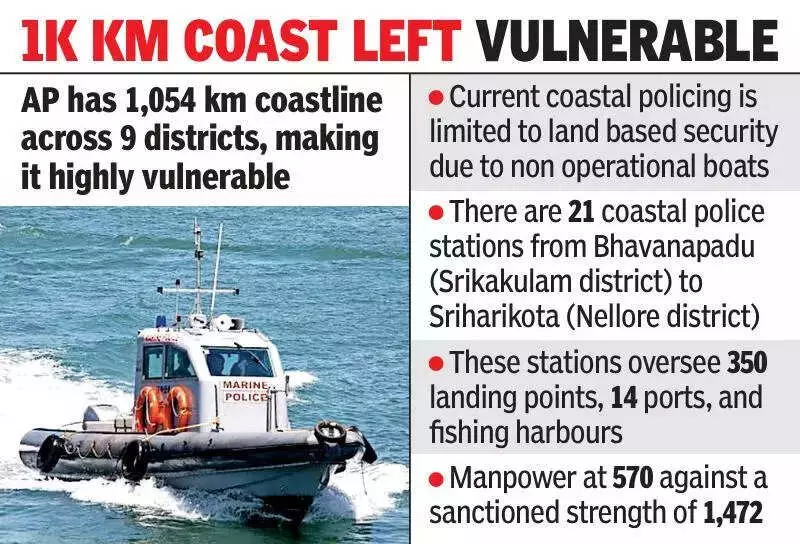
For over six years, the security of Andhra Pradesh's extensive coastline has been severely compromised due to a crippling lack of operational resources within the state's Coastal Security Police (CSP). A critical fleet of patrol boats has been entirely non-functional since 2018, leaving the 1,054-kilometer shoreline vulnerable to a range of threats from smuggling to potential marine terrorism.
A Strategic Coastline Left Unprotected
The state's coastline is not just any shore; it hosts a dense concentration of India's vital strategic and economic assets. Key installations dot the coast, including the Naval Science and Technological Laboratory (NSTL), the Bhabha Atomic Research Centre (BARC), the Naval Alternate Operations Base (NAOB), and the Defence Research and Development Organisation (DRDO) in Visakhapatnam. The city also houses the Eastern Naval Command and Hindustan Shipyard.
Further down the coast, major oil refineries in Visakhapatnam, ONGC, Reliance, and Gail facilities in East Godavari, and the crown jewel of India's space ambitions—the Sriharikota space station in Nellore—all rely on secure coastal waters. The current state of the CSP poses a direct risk to these national security and economic hubs.

The Root of the Crisis: Broken Boats and Thin Manpower
The most glaring failure is the complete breakdown of the CSP's maritime interception capability. All 18 fast interceptor boats—six small and 12 large—have been defunct since 2018. Officials state that until 2017, maintenance was managed by the central government through a Kolkata-based firm. When the responsibility was transferred to the state government in 2018, the funds for upkeep dried up, rendering the entire fleet useless.
This deficiency was starkly highlighted in a recent incident near Kalingapatnam, where CSP personnel, lacking a working boat, had to rely on local fishermen to help apprehend a vessel with 13 Bangladeshi fishermen on board. Patrolling is now largely confined to land, a grossly inadequate measure for coastal policing.
Manpower is another critical shortfall. The CSP's 21 coastal police stations, stretching from Bhavanapadu in Srikakulam to Sriharikota in Nellore, are operating with just 570 personnel. This includes 429 staff and 130 home guards, against a sanctioned strength of 1,472. This thin blue line is tasked with monitoring a vast area encompassing 350 landing points, 14 ports, and fishing harbours that serve approximately 150,000 fishermen families.
Improvisation and Future Plans
To mitigate the crisis, senior officers have been forced to adopt stop-gap measures. The wing has functioned without a Superintendent of Police (SP) rank officer for a year, managed by one DSP and one Additional SP under the supervision of a DIG. DIG Gopinath Jetti has introduced technological workarounds, deploying five drones capable of flying two nautical miles into the sea and enhancing CCTV surveillance on beaches.
CSP personnel now also join patrols conducted by the Indian Coast Guard and Navy and man the Joint Operations Centers in Kakinada, Nizampatnam, and Visakhapatnam. DIG Jetti has indicated that addressing the broken communication systems and reviving the boat fleet is slated for the third phase of the coastal security upgrade plan.
However, these measures are a poor substitute for a fully equipped and staffed coastal police force. The continued non-operational status of the interceptor boats remains, as officials themselves admit, the single biggest hurdle to effective coastal policing, leaving Andhra Pradesh's strategic shores in a perilous state of vulnerability.






