

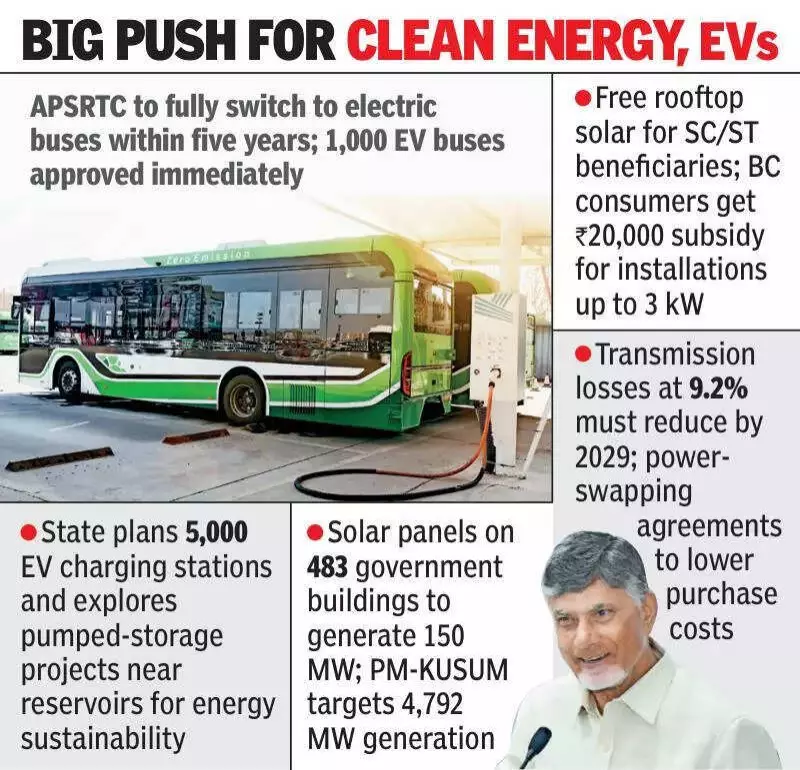
In a decisive move to reshape the state's energy landscape, Andhra Pradesh Chief Minister N Chandrababu Naidu has announced a comprehensive set of policies aimed at establishing the state as a clean-energy hub, ensuring reliable power, and alleviating financial stress on both the government and consumers.
A Five-Year Electric Mobility Roadmap
During a high-level review of the energy department on Tuesday, the Chief Minister issued a clear directive for the Andhra Pradesh State Road Transport Corporation (APSRTC). He mandated a complete transition to an electric bus fleet within the next five years. To kickstart this ambitious shift, the government has approved the immediate procurement of 1,000 electric buses.
To support this large-scale electrification of transport, the state will simultaneously develop a robust charging infrastructure by establishing 5,000 EV charging stations across its territories. This dual focus on vehicles and infrastructure marks a significant step towards sustainable public transport.

Solar Surge and Consumer Empowerment
The review meeting placed a major emphasis on solar energy expansion. Naidu announced a large-scale solarisation drive for government buildings, with plans to install panels on over 483 buildings to generate nearly 150 MW of power.
Empowering consumers to become prosumers—both producing and consuming power—was a key theme. Under the PM Suryaghar Muft Bijli Yojana, the state will provide free solar rooftop units to all SC/ST beneficiaries. For Backward Class (BC) consumers, a subsidy of ₹20,000 will be offered for installations up to 3 kW. The Chief Minister stressed that this enables households to sell surplus power back to the grid, creating an additional income stream.
Further, the state is targeting 4,792 MW of solar generation by utilising lands under the endowments and irrigation departments, aligned with the PM-KUSUM scheme.
Streamlining Power Systems and Industry Support
Naidu directed officials to rigorously ensure uninterrupted, high-quality power supply to all sectors—industries, agriculture, households, and commercial users. He set a clear target to significantly reduce the current transmission and distribution losses of 9.2% by 2029. To lower power purchase costs, he advised exploring power-swapping agreements with other states.
In a significant relief to industry, the Chief Minister announced the extension of incentives for ferro-alloy industries by another year, acknowledging their role as key industrial contributors. This extension, however, will impose an additional financial burden of ₹1,053 crore on the state exchequer.
Other directives from the meeting included studying pumped-storage projects near reservoirs, utilising fly ash from thermal plants, and collaborating with IIT teams on pollution-control solutions. The government also approved nine incentive components under the Integrated Clean Energy Policy, covering capital subsidies and GST exemptions.
Criticism of Past Policies and Financial Prudence
Taking a swipe at the previous administration, Naidu criticised the cancellation of Power Purchase Agreements (PPAs), which he claimed saddled consumers with a ₹9,000 crore burden despite the contracted power not being utilised. He asserted that his current administration has streamlined power finances and reduced this burden to zero without increasing electricity tariffs.
The review was attended by Energy Minister Gottipati Ravi Kumar, Chief Secretary K Vijayanand, and senior officials from Transco, Genco, and Discoms, underscoring the importance placed on this strategic sector overhaul.






