

Andhra Pradesh Government Revises Municipal Ward Structure to Enhance Local Governance
The government of Andhra Pradesh has implemented significant amendments to municipal corporation regulations, fundamentally altering the framework for elected ward members based on urban population metrics. Under the newly established guidelines, cities boasting a population exceeding 15 lakh will now be allocated 120 wards, a substantial increase designed to foster more granular and responsive local administration.
Visakhapatnam's Transition to 120 Wards
Visakhapatnam, a key metropolitan hub in Andhra Pradesh, stands directly impacted by this regulatory shift. With an approximate population of 19 lakh as per the 2011 census data, the city will see its ward count escalate from the current 98 to the newly mandated 120. This expansion is strategically intended to encourage greater representation of local leaders and more effectively highlight grassroots-level issues that are often overlooked in larger administrative units.
The move is anticipated to enable more focused governance and improved responsiveness to public needs, aligning with recent efforts to decentralize administration. For instance, Visakhapatnam was previously divided into eight zones, which was recently increased to ten zones to promote more accessible and doorstep governance. The ward increase is expected to further enhance coordination between municipal officials and residents, creating a more engaged and efficient civic ecosystem.

Historical Context and Population Growth
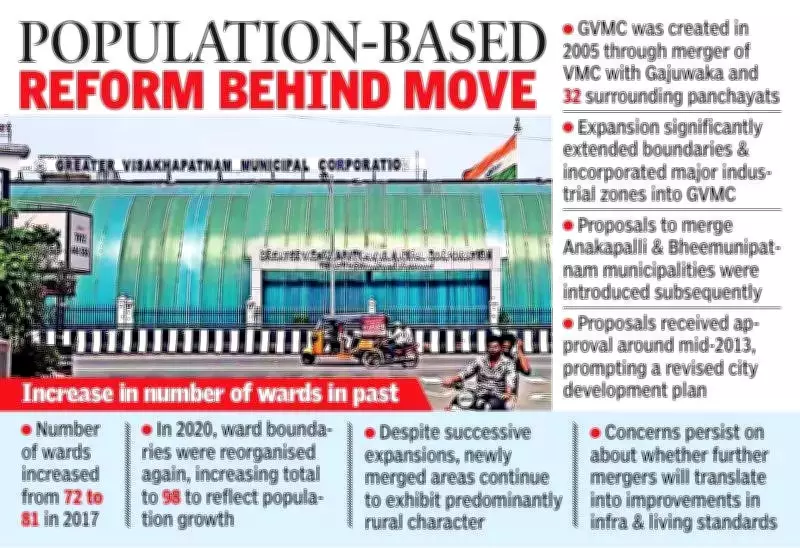
The evolution of Visakhapatnam's ward structure reflects its dynamic demographic growth. Until 2017, the city operated with 72 wards. That year, nine new wards were added, bringing the total to 81. According to the 2011 census, Visakhapatnam's core population was recorded at 17,30,320. Subsequent expansions incorporated areas such as Anakapalli (86,612), Bheemunipatnam (54,865), and five other gram panchayats (9,880), elevating the total to 18,81,686.
Further consolidation occurred in 2019 when five Bheemili villages, with a population of approximately 19,000, were merged into the Greater Visakhapatnam Municipal Corporation (GVMC), pushing the city's population to around 19 lakh. Based on the government guidelines at that time, which stipulated 90 elected members for cities over 15 lakh plus additional members for every 50,000 people above that threshold, Visakhapatnam was divided into 98 wards in 2020. The GVMC elections in 2021 were consequently conducted for these 98 wards.
Future Implications and Potential Expansion
The new rules specify that the 120-ward limit for cities above 15 lakh population applies strictly to the existing city area. However, this number is subject to change if municipal boundaries are expanded. A notable proposal is under consideration to merge 79 nearby villages from four mandals—Anandapuram (22 panchayats), Bheemili (26), Padmanabham (16), and Pendurthi (15)—into the GVMC.
If approved, this merger could lead to a further increase in the number of wards, as local MLAs argue that integrating these areas would support holistic development by improving infrastructure, healthcare, and civic services across the broader region.
Political and Community Perspectives
Jana Sena leader P Murthy Yadav has publicly endorsed the ward increase, stating that elevating the count to 120 will provide enhanced representation for local leaders. "This will improve the quality of debate and discussions in the next council. It will also bring more local issues to attention, which might otherwise be ignored," Yadav remarked, underscoring the potential for more vibrant democratic engagement and issue-focused governance.
The amendment represents a proactive step by the Andhra Pradesh government to adapt urban administrative structures to contemporary demographic realities, aiming to create more inclusive and effective municipal corporations that can better serve their growing populations.






