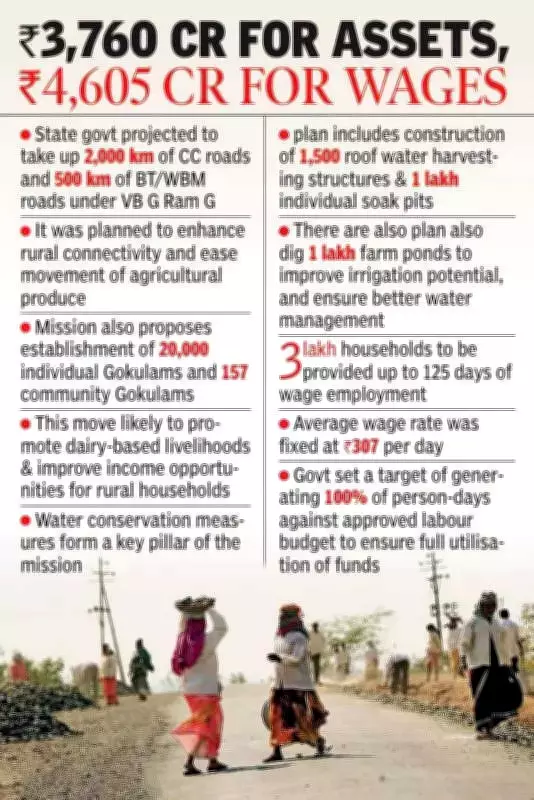
Andhra Pradesh's Massive Rural Employment Scheme Allocation Sparks Expert Scrutiny
The Andhra Pradesh state government's substantial budget allocation for the rural employment guarantee scheme has generated significant attention and raised questions among policy experts. During the recent budget presentation, the finance minister announced an outlay of ₹8,365 crore under the Viksit Bharat–Guarantee for Rozgar and Ajeevika Mission (Gramin), commonly referred to as VB-G RAM G.
Unclear Funding Structure Creates Confusion
What has particularly surprised analysts is the minister's failure to clarify whether this substantial amount represents only the state's contribution or if it also incorporates the central government's share in the total funding component. This lack of transparency has led to considerable speculation about the actual financial scope of the rural development initiative.
Senior Researcher Budha Chakradhar from Libtech India provided critical insight into the budgetary presentation. "The state budget shows an allocation of ₹8,365 crore for the new VB-G RAM G scheme. This number is surprising. It is not clear whether this amount is only the state's share or whether it also includes the Centre's contribution," he stated.

Chakradhar further elaborated on the potential implications of this ambiguity. "From the way the budget is presented, it appears to be a state allocation. If that is correct, the state could claim about ₹12,500 crore from the Centre, which would mean total spending of around ₹20,000 crore in a single year."
Historical Context Highlights Unrealistic Projections
The researcher contextualized these figures against historical spending patterns, noting that Andhra Pradesh never spent more than ₹10,000 crore on MGNREGA in any previous year, even during the peak of the COVID-19 pandemic when rural employment demands were exceptionally high. In normal years, the state's expenditure typically ranged between ₹8,000 and ₹9,000 crore on similar rural employment initiatives.
Chakradhar emphasized the importance of clarity in budgetary documentation. "If the amount indicated in the budget is the total share of both the state and Centre, it should be clearly mentioned, as the new scheme mandates a 40 percent share from the state."
Detailed Breakdown Without Clear Attribution
The outcome budget document provides some granularity about how these funds would be utilized. According to the documentation, ₹3,760 crore has been earmarked specifically for infrastructure and asset creation works, while ₹4,605 crore has been allocated toward the wage component of the mission. However, this breakdown still fails to clarify how much of each component represents the state's financial commitment versus the central government's contribution.
Historically, Andhra Pradesh has benefited significantly from central funding for rural employment schemes. The state was drawing almost 10 percent of the total Centre's spending on the previous National Rural Employment Guarantee Scheme (NREGS), thanks to the state's relatively low contribution requirement of just 10 percent over the past two decades.
Potential Implementation Hurdles
Experts warn that the new VB-G RAM G scheme could encounter substantial implementation challenges if there remains uncertainty regarding the exact financial resources to be allocated from the state's exchequer. The lack of clarity about funding sources and contribution percentages creates potential obstacles for effective program execution and could impact the scheme's ability to deliver on its promised objectives of boosting rural infrastructure, generating large-scale employment, and strengthening sustainable livelihoods.
The budgetary ambiguity raises important questions about fiscal planning and transparency in government spending, particularly for programs with significant social and economic implications for rural communities across Andhra Pradesh.