

Disability Advocacy Groups Call for 5% Political Reservation in Assam
In a significant move ahead of the upcoming Assam assembly elections, the National Centre for Promotion of Employment for Disabled People (NCPEDP) has joined forces with Young Indians (Yi) Guwahati to demand concrete political commitments for persons with disabilities. The organizations are urging all political parties to incorporate a 5% reservation in governance structures at every level within their election manifestos.
State-Level Consultation Highlights Political Marginalization
A comprehensive state-level consultation held in Guwahati on Saturday brought together more than 130 participants representing diverse stakeholders. The gathering included persons with and without disabilities, multiple Organizations of Persons with Disabilities (OPDs), and industry representatives from across Assam. During the day-long session, participants engaged in detailed discussions about political participation and collaboratively prepared a draft 'Charter of Demands' specifically tailored for the Assam assembly elections.
Arman Ali, the executive director at NCPEDP, emphasized the persistent challenges faced by the disability community despite existing legal protections. "Despite constitutional guarantees and progressive legislation, including the Rights of Persons with Disabilities framework, persons with disabilities continue to face challenges such as inaccessible polling stations, lack of accessible electoral information, limited representation in political processes, and inadequate inclusion in policy design," Ali stated during the consultation.

Key Demands and Campaign Background
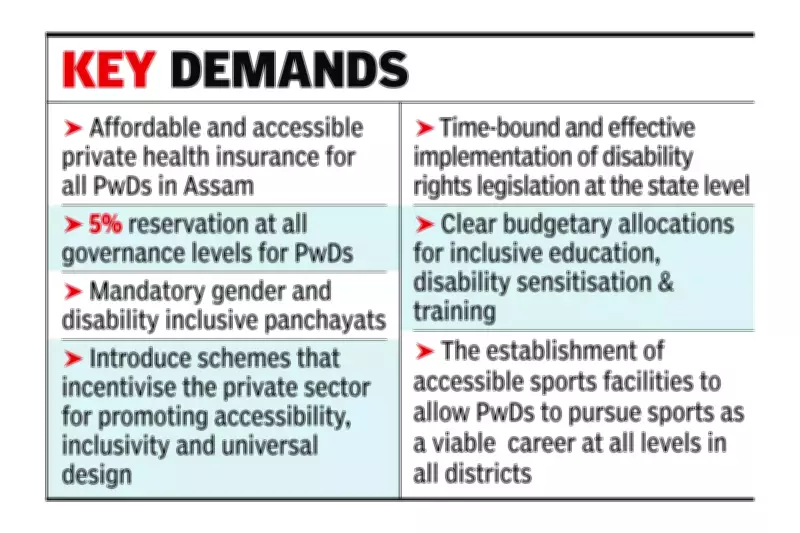
The consultation identified several critical areas requiring immediate political attention:
- 5% reservation for persons with disabilities across all governance structures
- Mandatory gender-and disability-inclusive panchayats
- Time-bound implementation of disability rights legislation in Assam
- Accessible healthcare infrastructure
- Comprehensive inclusive infrastructure development
These demands will be formalized into a comprehensive 'Charter of Demands' and submitted to major political parties contesting the Assam elections. The organizations have made a direct appeal for these points to be reflected prominently in election manifestos.
The Assam consultation forms part of NCPEDP's nationwide "Mera Vote Mera Bharat" campaign, which focuses specifically on improving political inclusion for persons with disabilities across India. Based on extensive national findings and multiple state consultations, the campaign highlights ongoing structural and systematic barriers that prevent meaningful political participation.
Significant Voter Base and Constitutional Rights
Ali revealed that Assam has over 2 lakh registered voters with disabilities, representing a substantial electoral constituency. "The response of political parties to these demands would be closely watched," he emphasized, adding that persons with disabilities are "asserting constitutional rights rather than seeking charity."
The executive director further stressed that "meaningful democracy requires equal participation of all citizens," highlighting the fundamental democratic principle underlying their demands. The consultation specifically aimed to address existing gaps by creating a platform where persons with disabilities could directly articulate their concerns and expectations from political parties.
NCPEDP's engagement efforts have been substantial, with the organization having interacted with over 20,000 persons with disabilities across nine state assembly elections and the 2024 general election over the past two years. This extensive outreach demonstrates the growing momentum behind disability rights advocacy in the political sphere.

The draft charter also emphasizes the need for political parties to recognize persons with disabilities as a significant and engaged voter group, moving beyond tokenistic approaches to genuine inclusion. As election preparations intensify in Assam, disability rights organizations are positioning themselves as crucial stakeholders whose demands cannot be ignored in the democratic process.





