

Assam's Political Landscape Intensifies Amid Bihu Celebrations
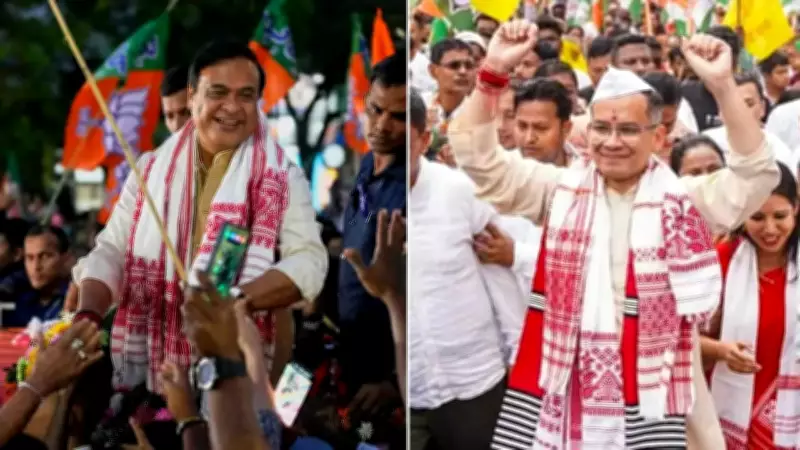
As the vibrant sounds of "dhul and pepa" fill the air and the fragrant "kopou phool" signals the arrival of spring and Bihu, Assam is experiencing a parallel surge in political fervor. The state's electoral battleground is heating up, with a defining contest that could reshape its political future. This election is far from routine; it represents a high-stakes face-off between Chief Minister Himanta Biswa Sarma and Congress challenger Gaurav Gogoi, charged with emotive issues ranging from identity politics to the Zubeen Garg death probe.
The Core of Assam's Political Churn
At the heart of this election lies a deeper transformation in Assam's politics. The Bharatiya Janata Party (BJP) aims to consolidate its gains through governance, welfare outreach, and its "jati, mati, bheti" plank, focusing on community, land, and homeland. In contrast, the Congress is attempting a reset by projecting new leadership and stitching alliances to tap into anti-incumbency and social coalitions. Adding complexity to this contest are post-delimitation realities, which have redrawn constituency boundaries and altered electoral arithmetic, particularly in minority-dominated seats.
Snapshot of Past Elections and Trends
Assam's current Assembly reflects a coalition-driven mandate. The BJP leads the 126-member House with 64 MLAs, supported by allies AGP (9), UPPL (7), and BPF (3). The opposition is led by the Congress with 26 seats, followed by the AIUDF with 15, along with one CPM member and an Independent. These numbers underscore how alliances remain central to government formation in the state.

The BJP's rise in Assam began in 2016 when it ended the Congress's 15-year rule, but it fell just short of a majority with 60 seats. This pattern repeated in 2021, with the party again winning 60 seats, relying on allies to cross the halfway mark of 63. Despite being the dominant force, the BJP has so far been unable to secure a majority on its own in the Assembly.
In Lok Sabha elections, the BJP's seat tally has plateaued at nine seats in both 2019 and 2024, after increasing from seven in 2014. However, its vote share has steadily grown, pointing to consolidation of support. Heading into 2026, with delimitation changes, welfare outreach, and a governance plank, the party aims to convert this consolidation into a standalone majority.
High-Stakes Contests and Key Battles
State elections are set to witness a series of high-stakes battles, with the spotlight firmly on a marquee face-off between Chief Minister Himanta Biswa Sarma and Congress challenger Gaurav Gogoi. As the BJP eyes a third consecutive term, the Congress is attempting a comeback by projecting new leadership, turning the polls into a referendum on governance, strategy, and political narratives in Assam.
Sarma vs Gogoi: The Battle for Leadership
Few contests in recent Assam politics carry as much symbolic weight as this one. Sarma, widely seen as the BJP's chief strategist in the Northeast, has been a dominant force since the early 2000s. Representing Jalukbari since 2001, he has steadily expanded his winning margins, culminating in a record victory in 2021. On the other side, Gaurav Gogoi is stepping into the assembly arena for the first time, contesting from Jorhat and positioned as the Congress's chief ministerial face. His recent Lok Sabha win from Jorhat, despite an aggressive BJP campaign, has injected momentum into the party.
Legacy Seats and Tight Races
Beyond the headline clash, several constituencies host intense battles rooted in legacy and narrow margins. Debabrata Saikia, the leader of opposition, will contest from Nazira, a seat long associated with his family. Having scraped through with a razor-thin margin in 2021, Saikia now faces a tougher test. Similarly, Ripun Bora, a former Rajya Sabha MP and state Congress chief, returns to the electoral fray from Barchalla, adding weight to his candidacy amid shifting political ground.

Switches, Alliances, and Political Realignments
The elections reflect the fluid nature of Assam's political landscape, marked by shifting loyalties and alliances. Ajanta Neog, once a Congress stalwart and now a BJP minister, seeks to extend her winning streak from Golaghat. Leaders like Biswajit Daimary and Atul Bora represent the importance of regional alliances within the NDA framework. Adding to the churn, Pradyut Bordoloi resigned from the Congress and joined the BJP, highlighting internal party dynamics.
Regional players and independent voices also influence electoral dynamics. Raijor Dal president Akhil Gogoi, a symbol of resistance during anti-CAA protests, contests from Sivasagar. The regional outfit joined the opposition alliance after finalising a seat-sharing arrangement, becoming part of a six-party bloc that includes the Congress, potentially reshaping contests in key constituencies.
Campaign Narratives and Key Issues
The campaign narrative is anchored in competing visions of identity, governance, and inclusion. For the ruling NDA, led by the BJP, the plank of "jati, mati, bheti" remains central, blending cultural identity with political messaging on indigenous rights and territorial integrity. This is paired with emphasis on development, welfare delivery, and governance.
The Congress and its allies pitch a counter-narrative centred on social cohesion, constitutional safeguards, and inclusive growth. Their campaign focuses on anti-incumbency, protecting minority rights, addressing alleged exclusions, and questioning equitable development.
Key Issues Shaping the Election
- Infiltration: Rooted in the legacy of the Assam agitation, this issue carries deep political resonance. The BJP projects actions towards fulfilling the Assam Accord, while the opposition accuses the government of targeting genuine citizens under the guise of acting against illegal immigrants.
- Eviction Drives: The ruling alliance highlights efforts to reclaim encroached land, framing it as necessary administrative steps. Opposition parties describe these actions as a humanitarian crisis, pointing to displacement and loss of livelihoods.
- Child Marriage Crackdown: The government projects arrests under the POCSO Act as strong measures against social evil, while the opposition questions implementation and alleges selective targeting.
- Development vs Distribution: The BJP emphasizes infrastructure expansion and welfare schemes, while the opposition questions the inclusiveness and equity of growth.
- The Zubeen Garg Case: Emotive concerns around the singer's death are invoked by opposition parties to question government intent, with the ruling side emphasizing steps taken, including a Special Investigation Team.
SWOT Analysis of Key Parties
Bharatiya Janata Party (BJP)
- Strengths: Himanta Biswa Sarma's assertive leadership, strong organisational control, governance pitch, and high-profile defections.
- Weaknesses: Risk of anti-incumbency after a decade in power, voter concerns around governance and employment.
- Opportunities: Divided opposition, continued focus on illegal migration as an electoral theme.
- Threats: Possible Congress revival under leaders like Gaurav Gogoi.
Asom Gana Parishad (AGP)
- Strengths: Part of the NDA alliance, pushing regionalism to appeal to Assamese voters.
- Weaknesses: Internal infighting, declining electoral strength.
- Opportunities: Leveraging alliance with BJP and government performance.
- Threats: Discontent within the party and perceived shift from regional identity.
Bodoland People's Front (BPF)
- Strengths: Recent victory in Bodoland Territorial Council polls, consolidation in Bodo tribal areas.
- Weaknesses: Stiff competition from NDA ally UPPL, vote division.
- Opportunities: Capitalising on BTC success to consolidate Bodo votes.
- Threats: Vote division and competition from non-Bodo voters.
All India United Democratic Front (AIUDF)
- Strengths: Key opposition player in constituencies with Bengali-speaking Muslim electorate.
- Weaknesses: Not part of any alliance, decline in popularity.
- Opportunities: Regaining lost ground by attracting voters from Congress.
- Threats: Internal dissent and possible defections.
Raijor Dal
- Strengths: Grassroots presence in Upper Assam, Akhil Gogoi's electoral success.
- Weaknesses: Inability to reach seat-sharing agreement with Congress, leading to vote division.
- Opportunities: Gaining from Congress defections in Upper Assam.
- Threats: Limited electoral experience and lack of coordination with opposition parties.
New Calculations in Assam's Poll Scene
Mainland parties are recalibrating strategies in Assam's evolving political landscape. The Jharkhand Mukti Morcha (JMM) has announced its return after a 15-year gap, fielding 21 candidates and targeting Assam's tea tribe community, which plays a decisive role in nearly 36 constituencies. Meanwhile, the Aam Aadmi Party (AAP) has released its first list of 14 candidates, fielding new faces across the Brahmaputra Valley.
With multiple parties vying for overlapping voter bases and constantly shifting alliances, the Assam elections are set to witness a fragmented and fiercely contested battle. The key question remains whether the Bharatiya Janata Party can deliver on its promises and retain its ground, or if the Congress can stage a meaningful comeback.





