Bankim Chandra Chattopadhyay's Descendant Joins BJP, Ignites Political Firestorm in Bengal
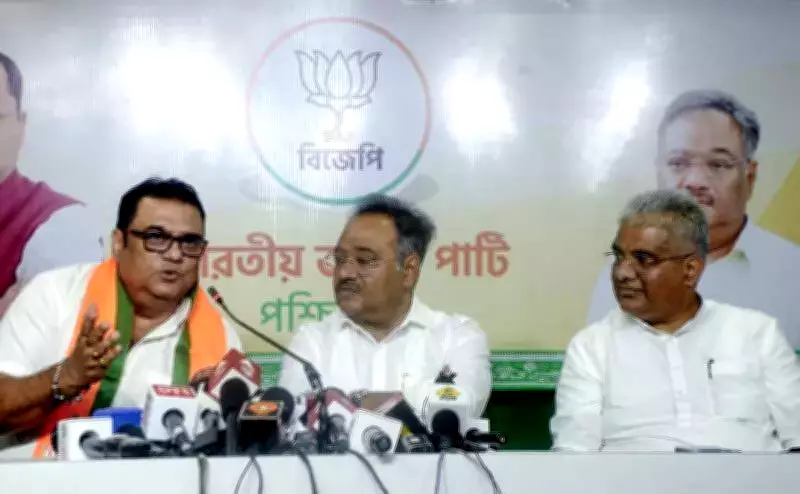
In a move that has sent ripples through West Bengal's political landscape, Sumitra Chattopadhyay, a seventh-generation descendant of the revered Bengali literary icon Bankim Chandra Chattopadhyay, formally joined the Bharatiya Janata Party (BJP) on Thursday. The event, held at the BJP's Salt Lake office in Kolkata, was attended by Union Minister Bhupender Yadav and Bengal BJP president Samik Bhattacharya, who welcomed Chattopadhyay into the party fold.
Timing Amid Vande Mataram Celebrations and Political Speculation
The joining comes at a politically charged moment, coinciding with the central government's celebrations marking 150 years of 'Vande Mataram', the iconic national song penned by Bankim Chandra. This timing has fueled intense speculation and controversy, with critics accusing the BJP of leveraging Bengal's cultural heritage to shape the pre-election narrative in the poll-bound state.
Union Minister Bhupender Yadav, addressing the gathering, emphasized the enduring legacy of 'Vande Mataram'. He stated that the song fortified the spirit of nationalism and patriotism during the British colonial era. "Bankim Chandra's 'Vande Mataram' is the very backbone of nationalism and patriotism in our nation. It is a profound honor to welcome a member of his esteemed family into the BJP," Yadav remarked.
Political Rhetoric and Vision for Bengal
Yadav further elaborated that Bankim Chandra's ideology and nationalist fervor would serve as an inspiration to propel Bengal forward towards the vision of a 'Viksit Bharat' (Developed India). He asserted that this would catalyze significant political and social transformation within the state. Echoing this sentiment, Bengal BJP president Samik Bhattacharya declared that Chattopadhyay's induction symbolized a "wind of positive change" sweeping across Bengal.
This development follows recent controversy where Prime Minister Narendra Modi referred to Bankim Chandra as "Bankimda" during the winter session of Parliament. While opposition parties criticized the BJP for allegedly disregarding Bengal's cultural legacy, the BJP itself initiated a parliamentary discussion on the 150-year legacy of 'Vande Mataram', highlighting the ongoing political tug-of-war over cultural symbols.
Chattopadhyay's Critique and Family Dissent
Sumitra Chattopadhyay, a former official with the state labour department, used the platform to launch a sharp critique of the state's employment policies. She alleged that data pertaining to lakhs of unemployed youths had been systematically deleted from government employment exchanges. "Despite having approximately 40 lakh names registered in the employment bank, there remains no tangible solution to the rampant unemployment crisis plaguing our state," Chattopadhyay stated.
However, not all family members are aligned with this political move. Sajal Chattopadhyay, another descendant of Bankim Chandra, has publicly urged that the litterateur's legacy not be exploited for political gains. He pleaded to keep both Bankim Chandra and 'Vande Mataram' distinctly "out of politics." Interestingly, he also expressed gratitude to Prime Minister Modi for the central government's decision to commemorate the 150th anniversary of 'Vande Mataram', indicating nuanced perspectives within the family itself.
Broader Implications for Bengal's Political Arena
This event underscores the intensifying political battleground in West Bengal, where historical and cultural icons are increasingly becoming focal points in electoral strategies. The BJP's recruitment of a descendant from a family synonymous with Bengali literary pride is viewed by analysts as a strategic effort to connect with the state's cultural ethos and challenge the ruling Trinamool Congress's dominance.
The controversy surrounding the use of Bankim Chandra's legacy highlights the deep-seated tensions between national political narratives and regional cultural identities. As Bengal approaches crucial elections, such symbolic gestures are likely to amplify political debates, with parties vying to claim the mantle of representing true Bengali heritage and addressing core issues like unemployment, as raised by the newest BJP member.