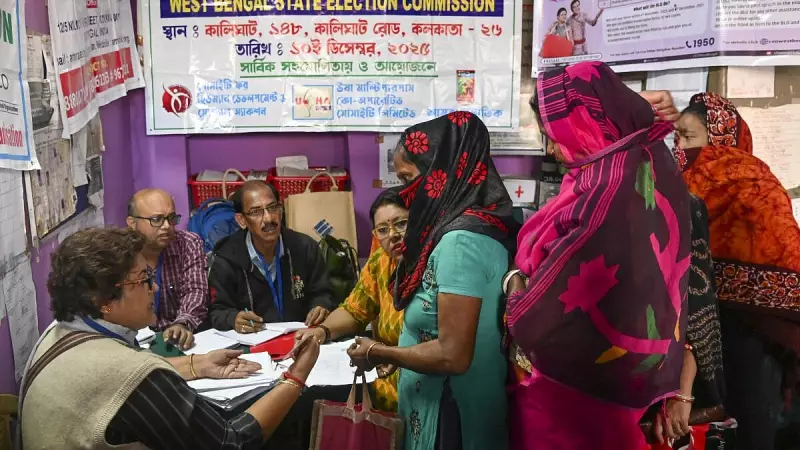
The Trinamool Congress (TMC) has seized upon the latest draft electoral rolls for West Bengal, claiming the data decisively disproves the Bharatiya Janata Party's (BJP) persistent allegations of massive voter list manipulation involving illegal immigrants. The figures from the Election Commission's Special Intensive Revision (SIR) 2.0 exercise show a total of 1.83 lakh suspected 'ghost' or duplicate voters identified for removal, a number that falls dramatically short of the '1 crore Rohingya and infiltrator' narrative often pushed by BJP leaders in the state.
The Numbers Behind the Controversy
According to the draft rolls published on 16 December 2025, the comprehensive revision process led to over 58 lakh names being removed from the state's voter list. However, the crucial breakdown provided by the Election Commission's categorization shows that the vast majority of these deletions were due to routine reasons like deaths and address changes. The subset specifically tagged as 'fake' or 'ghost' voters – meaning duplicate or non-existent entries – stands at approximately 1.83 lakh.
The TMC has been quick to highlight this specific figure, contrasting it with the BJP's repeated claims, both on the national stage and in West Bengal's political discourse, that millions of illegal immigrants, particularly Rohingyas from Myanmar, have been fraudulently enrolled to sway elections. The ruling party in Bengal asserts that the official data punctures a key political allegation used by the opposition.
Political Reactions and Narrative Clash
The revelation has intensified the war of words between the two major political forces in West Bengal. The TMC's statement framed the SIR 2.0 data as an official vindication, suggesting the BJP's claims were exaggerated for political mileage. "The EC's own categorisation shows the count of 'fake' voters falls far short of the BJP leader's repeated claims," the party noted, arguing that the narrative of 1 crore illegitimate voters has been debunked by the very process of systematic electoral revision.
For the BJP, which has made the issue of illegal immigration and voter integrity a central plank of its campaign in the eastern state, the new data presents a challenge. The party is yet to issue a detailed response to the specific 1.83 lakh figure but is likely to focus on the overall scale of deletions (58 lakh) and continue questioning the enrollment processes in border areas.
Implications for Electoral Integrity and Politics
The publication of the draft rolls marks a critical phase in the lead-up to future elections in West Bengal. The SIR 2.0 process itself was undertaken to cleanse the electoral database intensively. While the removal of any fraudulent entry is crucial for democratic integrity, the quantified data now provides a factual anchor for what was previously a heated but numerically vague debate.
The development has several immediate consequences. Firstly, it shifts the onus onto political parties to substantiate claims about voter list manipulation with hard evidence. Secondly, it highlights the role of the Election Commission's transparent categorization in informing public discourse. Finally, it sets the stage for the next round of claims and counter-claims as the draft rolls are opened for public claims and objections, a period that often sees heightened political activity.
As of now, the 1.83 lakh figure for 'ghost voters' stands as the official benchmark from the electoral authority, creating a clear point of contention in West Bengal's volatile political landscape and putting a specific number to a long-running and contentious allegation.