West Bengal Records Fifth Lowest Unemployment Rate in India at 3.6%
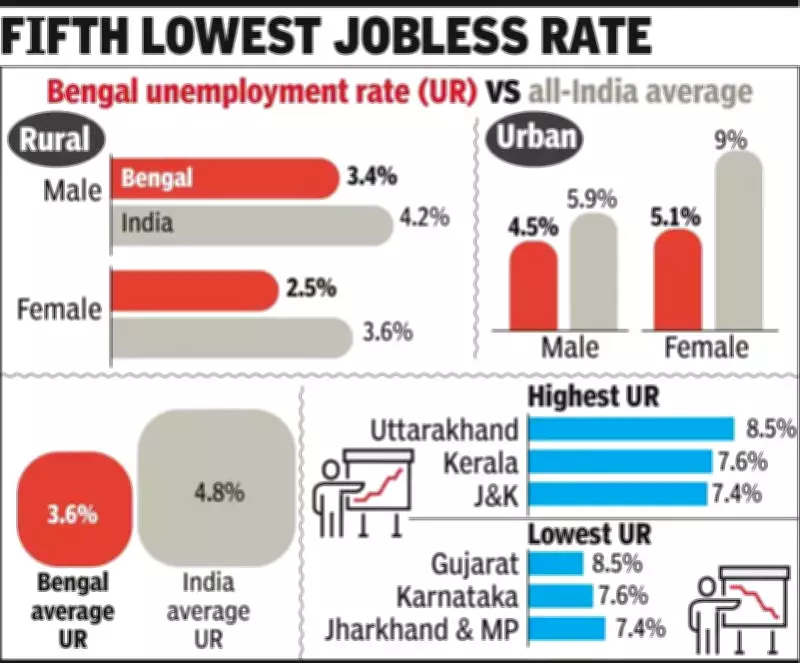
According to the latest Periodic Labour Force Survey (PLFS) for October-December 2025, released by the Centre on Tuesday, West Bengal has achieved an unemployment rate of 3.6%, positioning it as the fifth lowest in the country. This figure is significantly below the national average of 4.8%, highlighting the state's robust employment scenario amidst ongoing political discourse.
State Outperforms National Averages Across Urban and Rural Segments
The survey reveals that only four states—Gujarat (2.3%), Karnataka (2.7%), Jharkhand, and Madhya Pradesh (both at 3.2%)—have lower unemployment rates than Bengal. The gap is particularly striking for urban females, where Bengal's unemployment rate stands at 5.1%, compared to the all-India average of 9%. This makes Bengal's urban female unemployment the third lowest nationally, trailing only Gujarat and Karnataka.
Similarly, urban males in Bengal recorded a rate of 4.5%, against the national figure of 5.9%, contributing to an overall urban unemployment rate of 4.6% in the state versus 6.7% across India. Rural Bengal mirrors this positive trend, with a state rural unemployment rate of 3.1% compared to the national 4%. Within rural areas, males have a rate of 3.4% versus 4.2% nationally, and females stand at 2.5% against 3.6%.

Political Context and Government Initiatives
Unemployment has been a consistent political issue in poll-bound Bengal, now entering the campaign discourse. In response, the Mamata Banerjee government introduced the Banglar Yuba-Sathi scheme in its 2026-27 vote-on-account. This initiative offers a monthly direct cash transfer of Rs 1,500 to unemployed secondary school passouts aged 15-40, with registration set to begin on February 15. With an allocation of Rs 5,000 crore, the government estimates around 27.8 lakh beneficiaries, aiming to further reduce unemployment figures.
Bengal Leads in Other Labour Market Indicators
Beyond unemployment, Bengal excels in other key labour indicators. The state's worker-population ratio (WPR) is 43.8%, surpassing the national average of 40.2%. This includes a male WPR of 62% against 55.1% nationally and a female WPR of 26.4% compared to 25.5%.
Additionally, the labour force participation rate (LFPR) in Bengal stands at 45.4%, higher than the national rate of 42.2%. Male LFPR is 64.4% versus 57.8% nationally, while female LFPR is 27.3% against 26.8%. Rural Bengal records a higher LFPR of 46.4% compared to urban Bengal's 43.3%, reflecting the national trend where rural areas often show greater labour force engagement.
National Trends and Implications
The PLFS data also indicates broader national improvements, with rural unemployment across India declining to 4% from 4.4% in the previous quarter, and urban unemployment easing to 6.7% from 6.9%. Bengal's performance not only places it among the top states for employment but also underscores its potential as a model for labour market policies, especially in enhancing female participation and rural employment opportunities.